Showing posts with label Computers. Show all posts

Friday, April 06, 2018

The Death of the Scientific Paper


I’m sitting in my office at Université Laval, waiting for an opportunity to speak with my professor, and procrastinating revising a manuscript. My procrastination, almost always, is to read the internet, and today I’ve found a new article from The Atlantic, “The Scientific Paper is Obsolete”. 

The main thesis of this article is that the scientific paper as we know it today has outlived its utility. The author, James Somers, opens with a description of the niche the scientific paper was invented to fill: a short, incremental advance published as widely as a book but as readable as a letter, and permanent where a lecture is ephemeral. I’ve had conversations with academics in social sciences or humanities disciplines who express their surprise that books, which for argument’s sake are publications longer than about 100 pages, almost never appear in the list of citations in my scientific publications. I list 11 publications – scientific papers – on my C.V. with me as an author (always one of several, I have no sole-author publications) and I’m first author on 7 of those; this means I did most of the actual writing. I feel this experience gives me some perspective to evaluate the article in The Atlantic.

There are the expected jabs at the style and perceived readability of scientific papers, a criticism so widespread and consistent that I now mostly ignore it. I get it, you don’t get the enjoyment of reading a scientific paper that you get out of reading something else, and you put the blame largely on the abundant jargon and dense prose of typical scientific papers; James Somers also adds some mentions of “mathematical symbols”, which is indeed one major feature of many scientific papers that separates them from written works intended for a wider, non-specialist audience. But that’s the point – the intended audience of a scientific paper is not the general public, it’s other experts in that discipline. Know your audience. I guess James Somers does - scientists and non-scientists decrying the difficult prose of scientific papers to non-scientists is very popular in popular science articles.

This isn’t to say that a scientific paper cannot be or should not be highly readable to non-specialists and other members of  the general public, but to approach a scientific paper as a non-specialist and then complain about the jargon is to miss the point. I think one has to approach a scientific paper from a position of self-knowledge, in that I have to read a paper outside my area of expertise in a different (and more difficult) way compared to reading a paper that might cite my own work.

Another major difference between a scientific paper and something like an article in The Atlantic – and these two categories are of similar word-count, on average – is the abundant citations in a scientific paper. Every fact, every suggestion, every piece of information in a scientific paper that is not derived directly from the study itself will be cited; credit is given to the prior work that established those facts or provided those suggestions (unless the fact or suggestion is obvious or already widely known and established; we don’t cite Scheele and Priestly (1772) when talking about oxygen, for example). I find myself wishing for some citations and outside attributions while reading this Atlantic article because James Somers makes so many claims that I would like to dispute.

For example, here’s the third paragraph of the article:

The more sophisticated science becomes, the harder it is to communicate results. Papers today are longer than ever and full of jargon and symbols. They depend on chains of computer programs that generate data, and clean up data, and plot data, and run statistical models on data. These programs tend to be both so sloppily written and so central to the results that it’s contributed to a replication crisis, or put another way, a failure of the paper to perform its most basic task: to report what you’ve actually discovered, clearly enough that someone else can discover it for themselves.

 Are papers really longer in 2018 than they were, on average, in 1998, or 1978, or 1888? Are they more “full of jargon and symbols”? Are the majority of analytical computer programs “so sloppily written”?
And what replication crisis? Mr. Somers, have you not read the recent counterargument to the crisis-in-science narrative by Dr. Fanelli, recently published by PNAS?  

Moving on, one major criticism is that scientific papers are not a good way to express and describe complex results. Animations, something computers are quite good at, are useful tools for visualizing such complex concepts but are very difficult to express on a static sheet of paper, which the modern PDF (Portable Document Format) emulates. I agree, but I do not agree with the follow-up point that this renders the PDF hopelessly useless. A scientific paper is about the words, not the pictures or other visualizations. It’s about the information. Expressing that information in a way the audience can understand and use is the key skill of writing a scientific paper, and is distinct from the skills that create written material intended to be read by as wide an audience as possible. A scientific paper relies heavily on absolute honesty, and presenting all of the available and relevant information to allow the reader to independently decide to agree or not with the author’s arguments and conclusions. A magazine article pushes a particular interpretation of some phenomenon. A scientific paper pushes the phenomenon and then describes one (or sometimes more) possible interpretation of that phenomenon, usually in light of similar phenomena and potential alternative interpretations. A graph is not data, it's an expression of data. An animation is not an argument, it's one support for an argument.

Visualization is a technique, a way to take obscure numbers and show the patterns they contain. I struggle with it, constantly. The paper I am procrastinating working on right now has some decent figures* in it and I don’t see a need for a great deal of work on the visualization side of this paper. I have another project I’m working on that is at a much earlier stage and my current activities there are primarily concerned with visualization. I’m at the “data exploration” stage, where I throw the metaphorical spaghetti of the data at the metaphorical wall and see what sticks. That means lots and lots of images, mostly graphs I get my computer to make for me, and some scribbles on paper in my notebook.

*A figure is any image in a scientific paper, a photograph or map or, most commonly, a graph illustrating the mathematical relationship between two or more parameters. I tend to write papers by making the figures first, but that's a personal style and subjective workflow thing, and certainly not universal among scientists.

Back to The Atlantic

It’ll be some time before computational notebooks replace PDFs in scientific journals, because that would mean changing the incentive structure of science itself. Until journals require scientists to submit notebooks, and until sharing your work and your data becomes the way to earn prestige, or funding, people will likely just keep doing what they’re doing.

This is more interesting to me than the preceding description of competing formats for “computational notebooks”. I have seen suggestions from other people that concentrate on changing other aspects of scientific publishing, often the abolition of for-profit publishing companies (e.g. Here), but these suggestions and discussions do not express a dissatisfaction with the basic unit of scientific communication, the scientific paper. What would my job look like if both scientific papers and the way in which they are disseminated were to go away? Would I just be uploading lumps of code and datatables to some institutional server, whenever I feel like my analyses have answered some tiny question? Does my "Literature Cited" section just become a link-dump?


“At this point, nobody in their sane mind challenges the fact that the praxis of scientific research is under major upheaval,” Pérez, the creator of Jupyter [one of the competing calculation notebooks – MB], wrote in a blog post in 2013. As science becomes more about computation, the skills required to be a good scientist become increasingly attractive in industry. Universities lose their best people to start-ups, to Google and Microsoft. “I have seen many talented colleagues leave academia in frustration over the last decade,” he wrote, “and I can’t think of a single one who wasn’t happier years later.”

I had to look up the definition of “praxis”; I think it’s exactly what I was talking about, what does my job look like if the scientific paper and scientific publishing are drastically changed? Dr. Pérez apparently thinks my job would not change much. I’m not so sure.

There’s also a problem in that paragraph with a possible logical fallacy: confirmation bias. Lots of sad people leave, and then you find a few of them later and they’re happier. Well, good! Happier people is a good thing. But to then claim that it was the act of leaving that made them happier, and then extend that by implication that everybody should consider leaving, is to stretch beyond the available information into unsupported (and idealistic) speculation. If the only people who left were the unhappy people, then what about the happy people who stayed? Would they have also become even more happy had they left? Did the people who stayed unhappy, or became more unhappy after leaving avoid talking to you?

At this point I’m wandering away from the discussion about scientific papers. And I think the article did, too. It concludes with a weak suggestion that maybe some new tools will be useful (who could disagree with that? Tools are useful by definition) and that, hey Galileo, right?

I remain unconvinced in the impending death of the scientific paper. What I got out of this article was a description of some computer programmers and physicists with generally poor social skills but good ideas and skills related to generating and analyzing data. And that somehow this means the time I spend teaching ESL graduate students how to write better English that is also in the demanding, highly technical style of current scientific communication is somehow wasted.

Wednesday, February 12, 2014

Switching Email

In the past year or so, my Microsoft Network email account (@msn.com; Hotmail with a different suffix - I access it through hotmail.com) has been hacked three times. Each time, I become aware of the problem when my inbox starts filling up with two types of messages:
1. "undeliverable mail, returned", often with an identifier for a person I rarely, if ever, communicate with or to a clearly secondary email address for somebody. Obviously, there's a problem in the email address (it no longer exists, there's a typo, etc.) and the system returns the message to me.
2. "What is going on?" from people I actually do know. If that person has quoted "my" email in full, then I can see what was purportedly sent from my account. Embarrassingly, sometimes these messages are along the lines of "I haven't heard from you in ages! How are you doing? Why haven't you sent anything non-spam to me in so long?"

My sent mail box doesn't contain these outgoing messages. There is apparently some vulnerability in Hotmail that allows a malicious bit of software to read my list of contacts (even if they're not email addresses I've taken the trouble to actually add to "My Contacts") and send out a spam message to that list, all without going through the parts of Hotmail I can actually see. 

Hotmail switched from its own long-running unique email program to the online version of Outlook about a year ago, a move I lamented at the time because I knew Outlook's structure is well-known to those people who create such malware. Some large fraction of all viruses I have encountered are built specifically to exploit Outlook, and prior to Hotmail's switch I was effectively immune to all such nastiness. This is one major reason why I have never been particularly exercised about computer viruses - the vast majority of them have no effect on my computer beyond a bit of diverted processor resources when they accumulate, uselessly scanning my computer for their own triggers, based on Outlook or a number of prominent, mostly American, financial websites.

This repeated failure to address a clear security issue in Outlook, combined with Microsoft's terrible, terrible interface issues (the other reason I hate to use Outlook is just how goddam clunky it is - it's like they went out of their way to put tiny little barriers in the way of everything I want to do) and the byzantine weirdness that is the simple (and recommended-to-be-frequent) task of changing one's password (this slows down the hackspam, for a little while) has prompted me to switch my primary email to Google's we're-probably-not-evil system. The move to Gmail was suggested by a family friend on Facebook - thanks Don!

Given the way Google's tentacles extend so far across the internet, this is proving fairly straightforward so far - between Google and Facebook I've already switched over at least 80% of the non-individual email I expect to receive (that is, emails from computers rather than from actual people). The next part, in which I ask people who know me to switch their contacts list to the new address, begins now. This will probably take some time, but eventually I will be able to delete my @msn account and end this stupidity for good.

Monday, March 05, 2012

Monday Rant: UPS

About a week ago, I bought a new computer from a company in Calgary. They shipped it almost to me by UPS. UPS has never successfully delivered anything to me. Unlike other couriers, UPS company policies are all perverse when applied to residential delivery. They take as long to get an item off the truck and into a depot where it can be retrieved as they do to carry the item hundreds or thousands of kilometres. They only deliver during business hours, and the depot is open fewer hours in a week than an average bank. The website lies about the hours of the depot, which is located far away from anything in an industrial zone in Saskatoon.

The computer I bought arrived Friday, while I was not at home (of course). They gave it to my neighbour, a person I've never met. She hasn't been home since Friday, apparently, and still has it. I'm not worried about her, but it's annoying that UPS let her sign for it. I called and filed a complaint, which was less than satisfactory; the computer voice that speaks to me before I can talk to a real person informed me I can request the second attempt at delivery be with a neighbour. But in the follow-up call from the local depot I was informed it was company policy to ask a neighbour to accept the package, even on the first delivery attempt.

I don't actually care what UPS corporate policy is, I don't expect them to change at all because of my experiences. I want the ability to specify DO NOT SEND UPS when I buy something on-line - I will gladly pay more (and wait longer) for a different carrier. I've received packages carried by Fedex, Canada Post, Purolator, and DHL, and never had the kinds of problems I've had with UPS.

Monday, February 15, 2010

New Computer

I bought a new computer! My old home computer, an Acer 2200 Travelmate that I originally purchased in early 2004, finally succumbed to the onslaught of really nasty viruses. I picked up the third “rogue antivirus” in three months last week, an obnoxious beast calling itself “Antivirus Soft” that combined with Microsoft Windows Update in an unholy union that completely disabled the computer – it can no longer boot at all.

Anyways, in looking into the cost of professional attention for my computer, I discovered the price of laptops has dropped precipitously in the last few years. There’s a computer store not far from my home, a branch of Computer Trends, that offers repair services and sells new and factory-refurbished computers. I went down there on Thursday (they’re open until 8:00, happily) and dropped off the old machine. Complete virus removal and clean-up costs upwards of $150, but just pulling data off of an otherwise inaccessible hard drive costs between $40 and $60; they’ll drop what they can recover onto a DVD, but won’t go through the trouble of actually bringing the machine up to workable condition. I figured I’d just buy a new computer, and put what files I want from the old machine onto the new one and reformat the hard drive of the old computer. I don't know what I'll do with the old computer once I get clean and working.

So, the new beast is home. It cost only $400, which is amazing to me. From googling for reviews of this thing before I bought it, it seems like this machine was cutting edge about a year ago, and considered highly desirable about 6 or 8 months ago. Mine is a factory-refurbished individual, which is fine by me – I don’t need the newest game monster, but I would like to play some games newer than, say, 2004.

The new machine. An Acer Aspire 5532, with a 1.6GHz Athlon 64 TF-20 processor. I think processor numbers have become nearly meaningless in the last couple of years – my old computer was supposedly something like 2.0GHz, but this machine is much faster when it comes to actually doing things.

My choices were pretty good at the under-$600 range, but I went with this one partly because it was the cheapest (there were several attractive machines at around $500) and partly because it has Windows 7 and NOT Windows Vista. The salesman initially tried to convince me that Vista is a fine program and does not deserve its reputation (that reputation is: it’s complete crap); I was unconvinced. So far, Windows 7 is fine, and I was able to quickly turn off the Vista-style paranoid nanny-nagging fairly easily.

After messing about with it for a couple of days, I decided I wanted a new game. So I bought The Orange Box.

I put the “system requirements” sticker on the front of the box because it seems useful and was holding the case closed.

I played Half Life on my Playstation 2 a few years ago, on loan from Carlo. I know The Orange Box was a big deal because it includes Half Life 2: Episode 2, which was anticipated with near-feverish excitement when it was released (plus the sleeper-hit Portal). But, I’ve never played Half Life 2, nor either of the sequels, but all are included in this box! Five games for $30, not bad at all! I’m well into Half Life 2, and enjoying it greatly.

The one flaw with this computer I’ve detected so far is the shortage of USB ports. I bought a powered hub so I can simultaneously use an external hard drive (which require two USB ports because of power demands) and my proper mouse; I am not a fan of the touchpads on laptops.

Further contribution to the rat’s-nest of cables on my kitchen table.

Tuesday, September 29, 2009

Monday Rant: Hotmail

Microsoft's free on-line email system, Hotmail, has shat itself. Something horrible called "bing" has splattered itself all over the redirects, and hotmail is not currently accessible. Microsoft's help system is also utterly useless, and refuses to let me tell Microsoft directly that one of their most popular web services is down.

I want Microsoft to die. Die, Microsoft, DIE!

Friday, June 15, 2007

Monday Rant: Server Hangup

I know I'm way behind on my Monday rants. I assure you, it's not so much lack of rage that has slowed my ranting as it is a percieved lack of concise, well-defined targets. Much of what makes me angry I have either already ranted about (and the universe has not changed to suit my tastes! Grrrrr!), or constitutes a very broad topic worthy of more than a semi-coherent word salad on a poorly-structured blog.

Something has been happening at far too high a frequency lately. My email program, Eudora (v. 7.0) more often than not "gets tired of waiting for the server" when I ask it to check my email. The obnoxious little yin-yang symbol spins around for five minutes or so, then it displays that message. Idiotically 'cute' error messages are a subject for a rant another day. Like I said, this happens more than 50% of the time. I know of no way to prevent it, and short-circuiting such an event (by closing Eudora and restarting it) has no discernable effect on the probability of encountering the same error the next time I click "check mail".

Similarly, sometimes (less often, but still commonly) Eudora may pause part-way through downloading the current batch of recieved mail; the little blue bar-graph at the bottom of the screen simply stops, until I see an error message about "waiting for the server". Of course, like all proper errors, this error invariably leads to no emails getting downloaded until after I shut off Eudora, restart it, and try again. Also, when those emails do get downloaded, many of them come through duplicated.

These problems never happened when I was at SFU, using Eudora v. 6.0. So it's an uncontrolled experiment - I changed two variables at once. Oh well.

I also occassionally get server errors ("505") on some blogs and other websites, particularly when I try to leave a comment. Of course, this results in the total loss of the comment to the Void - why does the back button never preserve user-entered text?

I can't think of anything else to say on this topic, so just imagine that my own brain suffered a server error now instead of generating a concluding paragraph.

Sunday, May 27, 2007

Broken Desktop

My desktop computer at home died this week. It's an Athlon AMD 850 running windows XP, with four harddrives (physically, 2, with one subdivided into three parts by the version of windows 95 it was running years and years ago; the primary drive, with the OS installed on it, is a 20 gig).

I was innocently rearranging files on one of the smaller drives when it spontaneously rebooted. Spontaneous reboots have happened in the past, caused apparently by overheating in some cases, a virus or suite of viruses in another. Those reboots usually lead to a return to the OS, but with another reboot coming if I didn't fix the problem. This time is different - apparently, the computer cannot find the OS.

After the big table of hardware specifications (Hard Disk(s) Cyl Head Sector Size et cetera),
this is what it says:
"Disk error
Press any key to restart"

Or, again after the hardware table, it says:
"NTLDR is missing
Press any key to restart"


So I press a key, and it says:
"Searching for boot record from floppy..."

and proceeds to 'hang', rather than actually rebooting, showing the "Novell NetWare Ready Firmware v1.00 (940809)" screen. After a few seconds it says
"Boot Failure
Insert BOOT diskette in A:
Press any key when ready"

Pressing any key leads to
"Searching for boot record", then reboot, and
"Couldn't open drive Sgibberish
NTLDR: Couldn't open drive Ssamegibberish

It's pretty variable, sometimes when I try to start it I see one or the other message, sometimes pressing any key leads to a restart, other times just a hang. I have also seen it say something about missing a critical windows file, suggesting to me the action of a virus, or it says "Missing operating system". I have the Windows XP CD in the drive, but it keeps failing at "Searching for Boot Record from IDE-0..OK" then "Disk error".

Previous restart or boot failure issues had been caused by loose wiring, especially to the harddrives. I've checked those. It's also certainly not overheating - I left it off for two days and have tried again just now, with no luck. Also, the case is open and I just cleaned the fan and heatsink about 5 months ago.

My thought right now is that my primary harddrive, the 20 gig, is blown. Re-formatting this drive is an option - there's nothing of any great value on my home desktop - but I can't even get the system to recognize the CD in either CD drive.

Does anyone have any advice, or suggestions for on-line forums I could peruse for help?

Thanks.

Monday, April 23, 2007

Monday Rant: Video Play Delay

Every. Frickin'. Time. I click "watch the video", or I follow a link to YouTube, or to GoogleVideo, or any other video clip on the 'net, and it delays a bit before playing. That delay is NOT what this rant is about - this rant is about that delay should be LONGER.

What's wrong with Martin, today? Well, skimming the list we find the video thing that recursively started this thing. Huh? Meh, I'm probably undercaffeinated today so this may not make much sense. I blame lack of sleep.

Videos are typically big files, often several megabytes in size. Even with a nice, fast, connection, my computer cannot load the video in zero seconds. Yet the player seems to assume that since loading speeds are usually higher than playback speeds, the video can begin playing as soon as the first second or two has been loaded and buffered. WRONG. Without fail, the video pauses, sometimes for only a fraction of a second, sometimes for several seconds or even up to a minute, when the playback reaches the end of the section that's been loaded. Urgh. Why not wait, say, three full seconds before beginning playback, with a little note saying "loading" so you know your computer hasn't hung?

Wednesday, January 17, 2007

Monday Rant: Screen-savers

Modern computer screens are pretty close to immune to 'burn-in', the unfortunate effect in older monitors where continuously-displayed images become permanently 'etched' into a screen through complete saturation of phosphors or other image-producing chemicals. This phenomenon spawned the invention of the now universally-available program known as a 'screen-saver'. Presumably everyone reading this blog knows what I'm talking about.

Screen-savers were initially just programs that would blank out a monitor after a set period of inactivity, thereby preventing static images from burning into a screen. Moving images would be equally effective at preventing burn-in, so many more interesting screen savers were invented, based on the same underlying logic and algorithm. So now we have a zillion different screensavers available for computers, along with a host supplied as default settings on current computers.

As I said above, these are pretty much obsolete, rendered superflous to requirements by advances in monitor technology. Modern desktop CRTs (the old-school big-fat-TV things) can be left displaying a static image for days without suffering damage. Other types of monitors, like flat-panel-displays and laptop-type LCDs probably have shorter burn-in times, but these times are certainly on the order of tens of hours, at least.

My anger at screen-savers comes from the settings (particularly default settings) of screen-savers on computers, especially laptops. Why are the defaults, which so very few people bother to change, always set so short? I don't know how many scientific talks I've been to where the presentation computer (belonging either to the speaker or a presentation organiser, both of whom should know better), left to its own devices while the speaker describes a complicated figure or answers an audience question, kicks in the screen-saver and starts showing some useless fucking distracting animation shyte behind the (usually oblivious) speaker.

MacIntosh computers seem especially prone to this behaviour. I suspect that the particular combination of long battery capacity (4-5 hours, I think), stunningly-short activation times (3 minutes!), and widespread basic computer illiteracy among Mac-users chronically results in that superobnoxious multi-colour-floating-gauzy-point shitty display (apparently named "flurry") scrambling all over the monitor or screen (often very large) and pissing me off.


People, please! If you're going to be presenting, reset your computer's screen-saver timer to something half-way reasonable - I keep mine set to 120 minutes when on AC power, 30 minutes when on battery. Many screen-savers are so complicated they probably do nothing to preserve battery capacity compared to a static display. This 2-3 minutes bullshit has got to end. Or at least have the presence of mind to twitch the mouse while you answer audience questions, or when the bored-sleepy people suddenly perk up and look over your shoulder.

OK, wait a minute. If you're reading this, it's more than 99% likely* that you're reading this on a computer, most likely one that you personally have administrator-level access to, at least as far as screen settings go. RIGHT NOW, please check your screen-saver settings, and push that time-delay up into triple-digits of minutes. Yes, I know your screen-saver is pretty, and you like to watch the virtual fish swim, but you can click "test" for that whenever you want. Change those settings! RIGHT NOW!


This is the most annoying animated GIF I could find to illustrate my point with a flashy thing.

Monday, December 18, 2006

Monday Rant: Software Precedence

The new tabbed-browsing feature of IE 7.0 has one benefit I didn't expect - opening a new tab does not automatically bring that view up to the front of the display - so I can right-click/open in new tab a link in the middle of some page I'm reading, and not have to deal with the stupid computer bringing up that page when I'm not done with my current page.

Sadly, this feature is restricted to one aspect of one program. WinBlows assumes (wrongly) that any time I open a new program - email, word processor, whatever - that's the program I most want to be looking at and working on right now. Given the long load-times of many programs (particular offenders include PhotoShop 7.0 and Eudora 6.2), I might (usually) want to start a program up, but continue working on my current task. Frustratingly, my current task is usually interrupted by some half-loaded currently-unuseable thing that WinBlows mistakenly thinks I really want to look at. Typically, a half-loaded program doesn't actually cover the screen; instead, there may be a large white box in the middle of the screen, with aspects of my current task in the background, non-functional. Also, the mouse pointer gets converted into that fucking obnoxious arrow-with-small-hourglass design that is supposed to signal "working in background, you can still use your mouse" but actually signals "any input made during the next 10 seconds will be saved and applied to the not-yet-visible screen I'm busy slowly opening, with entertaining results".

What I'd really like in software design is an assumption on that part of the operating system that whatever I'm doing RIGHT NOW is the most important thing for the computer to focus on - any other programs also running (multi-tasking) or loading, or re-directing, are of lower priority for my attention. Don't pop them up on top of what I'm doing, don't flash the icon in the bottom bar, don't make sounds or present sliding, animated notices. I don't fucking care that a webpage has finally loaded; I'm busy writing a damn email.

Sunday, November 26, 2006

Old Computer Games - Part II: Diablo

After visiting Melanie's sister, brother-in-law, and indirect fitness a couple of weeks ago (short version: terrible driving weather), I decided to dig up my copy of the original Diablo, copyright 1996. We played a bit of Diablo II at a LAN store in Kelowna, and that was much fun.

Diablo is still a great game - it's very, very simplistic in storyline and actual play, but it's still mucho funno. I'm playing through as a Rogue, which means I shoot lots of stuff with lots of arrows, while wearing a chainmail bikini (the Rogue character is female). Funfunfun.

Diablo was one of the first games to devote random-generation to much of the game world. The basic village part of the world never varies, but the 16 primary dungeon levels are always randomly generated. Each block of four (dungeon, catacombs, caves, hell) has its own distinct style and layout rules, making the game, if not unique, then at least varied with each play-through. There are a range of side-quests that do or do-not happen in each play through, so there's a little more variety there (although, you almost invariably face The Butcher on level 2).

Sadly, this play-through-variety is necessary to really enjoy the game, because a) the items available for purchase don't refresh fast enough in a single game and b) more advanced dungeon levels are exponentially more difficult, meaning it's usually necessary to restart the game with a mid-to-high-level character in order to gain sufficient character levels and magical equipment to reliably defeat high-level nasties.

I'm probably going to restart the game, again, once I labouriously clear level 13, because the stupid frickin' Steel Lords are fucking difficult. I can take them one or two at a time, but larger groups are seriously dangerous. I need better armour, and high levels of the Lightning spell, to be able to take them.

I couldn't get Hellfire, the add-on package, working. Searching on-line for help, I stumbled across too many unrelated websites or just plain non-functional shit. If you put "Hellfire" and "cheat" into Google, you get many apocalyptic-christian websites, by which I was informed I would burn forever for cheating, regardless of the type of cheating.

Tuesday, November 14, 2006

Internet Upgrade-o-Rama

Today I updated two bits of internet software: I'm now using Internet Explorer 7.0 and Blogger Beta.

So far, nothing bad has happened as a result of either upgrade. IE 7.0 looks a little different from 6.0, but it adds "tabbed browsing", which is pretty meaningless to me - I'm fine with having multiple IE windows open simultaneously, but perhaps tabs take fewer computer resources. Blogger Beta is similarly unremarkable, though soon I plan to mess around with template options, add labels to all old posts (I've only got 160 or so, no problemo), and put those labels into an updated sidebar.

Exactly what I needed: an excuse to mess around on the 'net with some software.

Wednesday, October 11, 2006

Computer Games I Like

Carlo is apparently feeling threatened by recent posting-frequency around here (why, I'll never understand), and has recently put up a well-deserved thrashing of IGN's "Top 100 Games" article.

He also posted a quickie top-3 list of best-games-ever:


1. Star Wars: Tie Fighter
2. Sid Meier's Civilization
3. Sim City

In response, I commented on his blog, and left my quickie top-5 list:


1. Star Control II (yes, the sequel)
2. Civilization (the first one)
3. Battle of Britain (circa 1992)
4. Battlefield 1942
5. Ultima V
I'll explain my choices here. But first, I'll point out that I only include games I've actually played - other games were probably better and/or more influential (nothing better than SC II), but I didn't personally meet them.

1. Star Control II
1992, Accolade
This is, in my opinion, the greatest computer / video game ever created. It's too bad this game wasn't somehow more influential on other game designers. I've never seen another game that I could point to and say "that game traces some key concepts to SCII". Regardless, SCII is at the top of my list because I had more fun playing that game than any other.

Wikipedia entry on the Star Control series here.

Incidentally, this awesome digital goodness is available for FREE DOWNLOAD because of some very, very nice people, who ported the 3DO version (with speech and other effects) into PC format and released it to the world.

2. Civilization
1991, Microprose
This game gets the number-2 spot because of the sheer quantity of time I spent playing it and its sequels (Civ II, Civ III, not yet Civ IV). I dunno, I guess I just really like god-games.

Wikipedia entry on Civilization (computer game) here.

3. Battle of Britain
1991? Accolade?
OK, I can't find any information online (in the time I'm willing to spend looking) about this game. Trust me, this marked the first (I'd ever seen) flight sim that showed more detail than green = ground, blue = sky, and darkline = enemy plane. So much fun shooting stuff...

4. Battlefield 1942
2002, Electronic Arts
Run around online and blow stuff up, real good. Except with some level of cooperation, and the ability for "the community" to post modifications, rendering the game more realistic (eg, realistic muzzle velocities for guns), less realistic (eg, increasing the available ammunition or vehicles) or just weird (eg, "monster truck now bigger!"). I never actually owned this game, but the few times I played it on other people's computers were great fun.

Wikipedia entry on Battlefield 1942 here.

5. Ultima V
1988, Origin
There had to be a role-playing game on the list, so this is mine. Enough said, I think.

Wikipedia entry on Ultima V here. My thoughts on this game here.

Looking at my list, I think I just dated myself (I'm 28, in case you didn't realise). So perhaps there is some nostalgia playing a role in the above list.

I also think I probably should have included Doom on the list, somewhere (below number 1, SCII is still better), given it's massive influence and popularity. Also funnitude.


Also, formatting this in Blogger's post editor was unusually painful, primarily due to the block quotes. Urgh.

Thursday, August 24, 2006

Monday Rant (Delayed): Printers

Printers have not advanced at the same rate as other computer peripherals, which is very strange, considering how many people insist on printing every Gould-Damned thing out.

It took us weeks to purchase a new printer for the lab - and we didn't even want colour! For some reason, finding a printer that will work almost right out of the box for less than $1000 is nearly impossible. Our Brother HL-2070N still doesn't work properly, months after we gave up trying to reconfigure it, again. It's current quirk is to put white dots down one column of the page, at random intervals. Of course, it never does this when I actually try to fix the damn problem.

Every printer I've ever met had some sort of annoying problem - toner issues, paper feed jam issues, extremely long warm-up times (to the point of saving all print jobs for the end of the day, and picking up your printouts the next morning), etc. ad nauseum. Why?

Why does my inkjet at home insist on having a functional colour cartridge installed when I'm just printing a black-and-white document? Why does every printer need it's own unique driver, which is invariably no longer available on the relevant website?

If you think about it, modern home-and-office printers are pretty amazing technology. Inkjet printers spray micro-meter scale droplets of ink onto a moving page in a pattern too precise for most people to resolve. Laser printers (they contain frickin' lasers!) modify the molecular structure of the surface of a moving sheet of paper in an even more precise pattern.

Given these Sci-Fi heights of sophistication, why the fuck does my printer's ink dry up if I don't use it for a week? A wet paper towel in a bag?!? WTF? This thing is as sophisticated as a cell-cell adhesion protein, and I'm supposed to look after it with a wet paper towel in a bag?

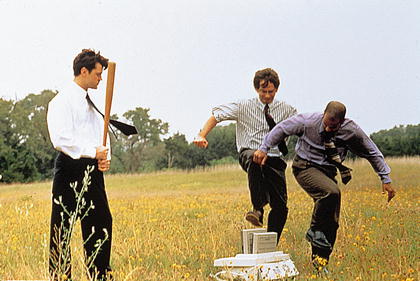
** The above picture is a still-frame from the movie Office Space. PC-Load-Letter my ass!

Wednesday, June 21, 2006

Old Computer Games - Part I: Ultima V

Last night, I stumbled upon the disks for Ultima V, a top-down, party-based RPG published by Origin in 1988. At the time, I'm sure the 3.5" floppies were considered state-of-the-art.

Now, modern computers won't run that game at all. Many really new computers (like the laptop I'm writing this post on) don't have floppy drives. Fortunately, I own 5 computers, three of which are horribly obsolete - a Pentium 133 tower, a 486 DX2 50 horizontal desktop (remember when those numbers used to mean something?) and a semi-functional 486 laptop.

These had been collecting dust for a few months, but since my home AMD 850 / XP won't deal with Ultima V, I flashed up the ancient 486. No luck! The first disk apparently has a few bad sectors on it, and these cause the computer to crash unpleasantly. Not expecting success, I swapped out the CPU box for the Pentium - and Voila! Windows 98 lives up to its old reputation as games-friendly.

There's a weird glitch when it comes to quitting the game, but so far everything seems OK. I wasted much time today digging up the old manuals and hint guides for the game online, so tonight I may spend some time with a classic. Lord Blackthorn, consider yourself warned.

Wednesday, May 24, 2006

Monday Rant (Terribly Delayed): Computer Cheating

This rant is very, very late, and for that, I apologise. No apologies for the content to follow, though.

Computer games, generally, do not suck. But many games share a common "feature", a coding-shortcut, that sucks, and sucks hard. This coding-shortcut manifests in a wide range of computer games as computer cheating. Apparently, programming the artificial intelligence of a piece of software to be relatively good, and forward-thinking, in just about any game is damn-near impossible. Fine, I know next to nothing about Computer Science and Artficial Intelligence, so I'm not going to rant about that difficulty. I am going to rant about the lazy bullshit programmers and game designers put into their games to compensate.

Computers are very good at certain things. Essentially, any task that can be reduced to lots and lots of calculations, will be something that a computer is good at, and a human not so much. The disparity between species in this realm is so great that nobody has bothered to create a game that explicitly takes advantage of this - with the possible exception of chess, invented long before the electronic compute.
This skill at calculation makes computers useful for entertainment purposes, as they can be used to simulate pretty much any experience, many of which make good games. More subtly, this makes computer players (as opposed to human players) very good at certain within-game tasks. For example, in any game simulating gunnery, the calculations involved in the simulated world for balistics and other factors important for shooting something are trivially easy for the computer - but relatively difficult for the human. So you get Idiot Savant computer players - it can't position it's units in the best ambush site, but if the human wanders within range, the human gets zapped. In games in which gunnery is of prime importance, such as First Person Shooters and many "arcade"-style games (think StarControl, or 1943), the computer player is typically a horrible moron, incapable of anything even resembling thought, but has accuracy rates up around 100%. Not good for simulating realism.

Other games require strategic (or at least tactical) thinking. God-games, like Civilization, and Real-Time-Strategy games (a misnomer; these games are universally Real-Time-Tactical) suffer the most from this. Computer players in these games typically seem to follow a basic, inflexible set of rules, to the point that most of the in-game features, like "diplomacy" and "long-term planning" are lost in a sea of automatic responses. All of the games in the Civilization series (NB: I haven't played Civ IV yet, but I'm not expecting an exception) have had this problem in a terrible way. "Construct alliances! Use diplomacy to win!" Bullshit. The computer always responds the same way: attack on sight.

So, to get around the inherent difficulty of programming a computer to think, game designers allow the computer to cheat. In shooter-type games, the cheating is obvious in the form of inhuman accuracy and a sense of timing that destroys the defintion of the word "reflex". In strategic games, the cheating must be inferred from the ridiculous achievments accomplished by the electronic idiot. Time to produce, the rate at which orders can be given, and perfect knowledge of one's opponent are all common strategy-game cheats by computers.

This brings me to the second part of my rant: games built with a sense of accomplishment.

Why do game designers make the computer cheat? Computers have no desires, no emotions. They don't cheat because they want to win, they cheat because they were told to. By game designers, many of whom apparently labour under the delusion that a game player, a human game player, plays a game for the sense of satisfaction, of accomplishment, achieved at the end of the game, or at key milestones within the game. NO. Fuck! I'm playing the game to burn some time - I'm fucking bored, not seeking a sense of self. I have work; this and my interpersonal relations will provide any needed sense of accomplishment - I play computer games to activate different regions of my brain, and to waste a few hours on a boring, boring Sunday. Repeating the same goddamn level 18 times, memorizing a particular and very specific series of button-presses, and reloading my saved game over and over and over and over does not contribute well to the "enjoyable time-wasting" aspect of computer games!

Stop fucking cheating! I just want to win; I don't care if you think it's too fucking easy! I WILL NOT look back on completing some game in a year with fond memories of triumph - I'll use other parts of my mind for that (probably the parts most affected by alcohol, actually). Why, oh why, can't I find a game that lets me accomplish my goal of something-to-do-while-dinner-cooks!?!?!?!

Arg.

OK, not my greatest rant, and delayed by 10 days. I'll try to work up a bit of froth again this week, so I'm can get back on schedule next week.

Monday, May 08, 2006

Monday Rant: Macintosh Computers Suck


This morning, my supervisor moved the lab's aging iMac from a benchtop area to a recently-temporarily-vacated desk so an undergrad work-study could use it more comfortably. This innocuous event provides the start point for one of my more frequent rant: Macs suck.


Proponents of the Macintosh line of computers like to make statements about the supposed superiority of their machines relative to Windows-based PCs. This rant will not consider the relative merits of Unix or Linux-based computers, as I have zero experience of them.

Claim number 1: Macs are more intuitive and therefore easier to use.
No, this is incorrect. Modern Graphical User Interfaces (GUI) have obviously experienced a great deal of convergent evolution, so it's immediately apparent that there really are not many major differences between Windows XP and Mac OS 10.3. You use your mouse to point at an icon on the screen, and a double-click activates that program or opens that file. If there's something easier to use about how a Mac does this, I haven't seen it. There are some minor points, mostly relating to the esoterica of computer-human interface design, but nothing about the basic operation of a Macintosh seems different from that of a Windows computer.

Claim number 2: Macs are friendlier.
What does this even mean? Do you have some strange affinity for pretty coloured plastic backings? For single-button mice? For commercials featuring plain white backgrounds? I hardly think a sticker price 1.5x that of a similar PC counts as "friendlier". Maybe it's their customer service - but shouldn't a good computer never require a call to customer service?

Claim number 3: Multi-tasking on a Mac is easier
OK, now I get to make my outrageous (but true!) claim about Macs: THERE'S NO MAXIMIZE. Sure, you can arrange all the stuff you're working on on the screen at once, and see your word-processor at the same time as your spreadsheet. Woopdeedoo! You can do that on any GUI!!! What you CAN NOT do with a Mac is push one button and make your currrent task occupy the ENTIRE SCREEN. This small, apparently minor difference causes no end of grief for me when using a Mac - if I slide the mouse all the way to the right of the screen, and click on the slider there to move up or down on the thing I'm looking at, I expect the thing I'm looking at to move up or down. I don't expect to activate some other program, or accidentally click on the desktop (finder). AAaarrgh. I don't think I can accurately convey in words how much this lack-of-feature bugs me. Yes, the picture of a kitten on my desktop is lovely; that doesn't mean I need to see the edge of it at all times!

Claim number 4: Macs are inherently superior in available software for graphic design and other functions
So what? Do I look like an animator? Do you? Why do you need a computer capable of running $5000 professional graphic-design software if you never plan on buying such software. It's like claiming PCs are better because some nuclear power plant uses specialized PC-based software to monitor the cooling towers - why does this "feature" interest anyone?
Also, I've never actually heard this claim backed up with any kind of reasoned argument or reference. I expect there are artists out there who have recently switched to a Mac for their work because of superior available software. But superior available software changes constantly, and I expect the switch the opposite direction happens at about the same rate.

Claim number 5: Macs are safer because they're immune to viruses
Bullshit. This is just a straight-up lie. There are fewer viruses for Macs because there are fewer Macs. If you were to design a virus with the explicit goal of disrupting the lives of as many people as possible (because you are a wanna-be anarchist "haxxor"), you obviously would target the most common software around - which is usually Microsoft Outlook, itself an execrable piece of software specific to PCs. Something like 90% of home and business computers are Windows-based PCs. Macintosh computers account for something less than 5% of all computers sold. Why would a virus-designer bother attacking a Mac?
Actually, there are some viruses out there specifically designed to attack Macintosh computers. They just don't make the news because 90% of people with computers have PCs and don't give a damn about what happens to their art-fag arrrogant prick neighbour's Mac.

Claim number 6: Macs are faster
Based on what? Benchmark processor speeds have been shown to be pretty meaningless to the majority of computer users, because very few people run programs that suck up ALL of a computer's processing power. Other hardware and software factors, like available RAM or something called a "kernel" which I know nothing about, also have large impacts on how quickly your computer carries out a particular task. And for the cost of a top-end, fastest-available Macintosh, I can buy a barely-past-prototype PC that blows the Mac out of the water in most tasks, and have money left over to buy the software that actually does those tasks.

Finally, there are several "features" of Macs that piss me off.
1. No maximize. Seriously, this bugs the hell out of me
2. The Dock does not include infinity. What? I mean if you slide your pointer to infinity on the side of the screen where the dock is (ie, push your mouse past the edge of the screen), nothing in the dock is clickable. That's just bad interface design
3. Single-button mouse. Right clicking is good. Right clicking is valuable. So are scroll wheels, for that matter.
4. Cute colourful things. Not just the iMacs, but also the damn commercials. How vapid do you have to be to base a $2000 decision on orange-or-blue?
5. Background assumptions. Both the software and hardware engineering in a Macintosh shows obvious signs of rampant paternalism - you have no choice, you will do this thing in exactly the way we tell you, no you're not allowed to change the settings. PCs with Windows do this too, more so in recent versions of Windows, but not nearly to the same extent as the Macs.
6. No upgrades possible. Maybe I'd like to not have to buy a new computer to get a new video card?

OK, I'm done. Back to pretending to work.

Monday, May 01, 2006

Monday Rant: Computer Mice

Mouse technology has failed to keep pace in quality advancement with other aspects of personal computing.

This is my first of probably many Monday Rants.

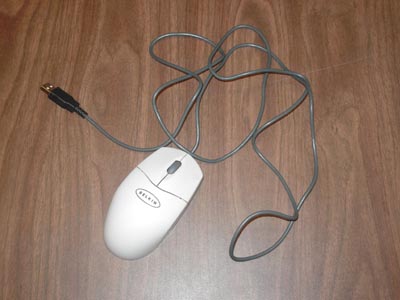
I'm writing this on my Acer TravelMate 2200 laptop computer, which came equiped with a touchscreen mouse-thing. I hate that screen. That can be the subject of a different rant, though. To compensate for the crappy little screen, I bought a Belkin USB ball mouse the day after I got this computer. I think it cost $10.

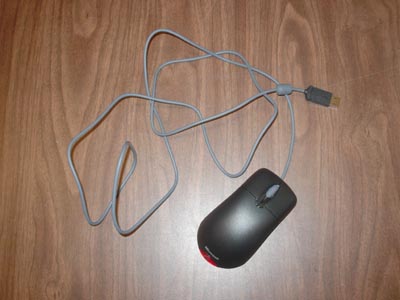
Last week, it got sick and died. Not dead, really, since it still kind-of works, but it now squeaks like a real mouse, and the vertical movement rate is different from the horizontal. That's irritating, so I went and bought a Microsoft optical mouse.


Why do optical mice suck? Seriously, can anyone tell me why something so cool as to contain a frickin' laser has to be so annoying to use?

Maybe it's just me. Maybe I'm the only person on the planet to whom this happens. But when I use an optical mouse, any optical mouse, it occasionally randomly throws the pointer across the screen. I'm happily wiggling my mouse, pointing and clicking contentedly, and suddenly the pointer, for no apparent reason, goes over there.
Smacking the mouse, or picking it up and slapping it against the desk, seems to temporarily fix the problem.

But it's still very annoying. And I suspect it only happens to me, implying that this is somehow my fault.


OK, for a first rant, that was extremely lame. Feel free to mock me and my defective rage in the comments section.