Saturday, November 26, 2016
Book Club: The World Until Yesterday
Friday, June 10, 2016
My Leatherman
I had my Leatherman tool, on my belt, for seven years. My soon-to-be-PhD-advisor-at-the-time, Dr. Steven Siciliano, gave me a Leatherman Charge TTi - a top-of-the-line multitool - before my first field season with him and his research group in 2009. He gave it to me around March or April of that year, and I've worn it on my belt nearly every day since then.
That's around 2500 days of that lump of complex, hinged, bladed metal on my left hip. I've gone through three sheaths and I don't know how many subconscious hand-passes over my belt to make sure its still there.
Early this year I accidentally tried to take it through security at Pearson International Airport, on my way to visit Charlie in February. The security personnel were quite nice and polite about it, and let me mail it back to myself in Waterloo; it was waiting in my mailbox when I returned a week later.
At the end of my 6-week-long bookended-by-conferences early-summer-2016 fieldwork I sent it in to Leatherman's facilities in Burlington, Ontario, for warranty repairs. Before I flew from Calgary to Fredericton, I went to Canada Post and sent it to Ontario. Tonight, it has been returned to me.
Or rather, an updated substitute has been returned to me, and my Leatherman is no more. Because the Charge TTi has been replaced in the Leatherman Inc. lineup by the Charge Titanium, that is what I now have. This new Charge Titanium is a thing of beauty, a tool of vast utility that fits perfectly with the accessories (sheath, screwdriver bits) I was instructed not to send in. But it's not my Leatherman (yet).
The knife blade is flawless, not the chipped, scratched, and haphazardously-sharpened blade I used to cut ludicrously-fresh tomatoes and pears on the top of an Arctic mountain.
The saw blade is perfect, not the scratched, difficult-to-open tooth I used to cut branches and an uncountable number of zipties (using the sharp hook on its tip) on seven years of Arctic expeditions and Prairie Rivers canoe trips.
The file - both sides! - is clean to the point of optical illusion along its cross-hatched surface, and bears no trace of the steel soil-gas probes I filed and filed and polished and cursed before fitting their machinist-perfect but field-work-distorted hammer-cap on to drive into the rocky soil of the Arctic polar deserts.
The pliers are smooth and shiny, not the sticking, misaligned grip I pulled endless nails from endless boards with.
Even the scissors, tiny and sharp, are quite excellent, and not the cutters I pushed and squeezed through paper, string, cardboard, and plastic over the majority of a decade.
I'm going to enjoy and appreciate this tool over the next seven years - or more! - but I do feel like an old friend has been lost, and a concrete symbol of my PhD has disappeared.
Thank you, Leatherman, for making such fine tools. I hope my use of this new multitool lives up to the legacy of the previous one. And thank you, Dr. Siciliano, for sending me down this pathway seven years ago.
Tuesday, January 19, 2016
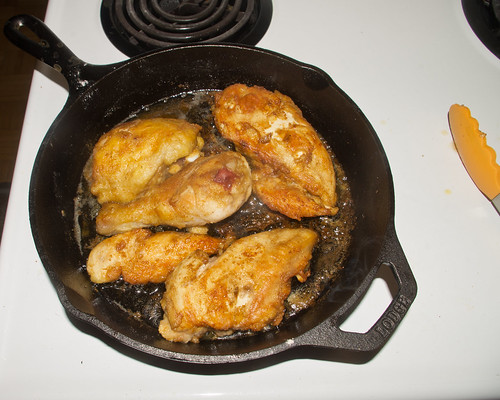
Betty Crocker Cookbook #18: Skillet-Fried Chicken (pg. 321) - 160116
Sunday, January 17, 2016
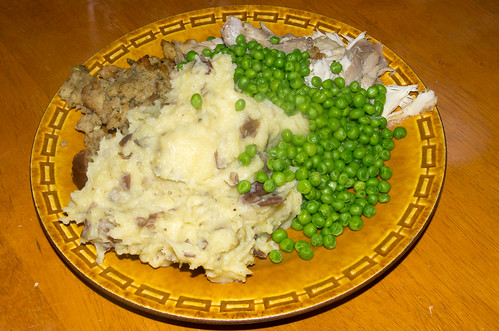
Betty Crocker Cookbook #13: Mashed Potatoes (pg. 464) - 160110
Saturday, January 16, 2016
Book Club: War: A Crime Against Humanity
Sunday, November 23, 2014
Book Club: Crawling from the Wreckage
Gwynne Dyer
Random House, 2010
This book is a collection of Gwynne Dyer's columns - syndicated in many, many newspapers around the world - from 2005 to the end of 2009, re-organized into thematic chapters such as "South Asia" (chapter 8) and "Nukes" (chapter 17), each containing 3-5 essays ranging in length from about two pages up to about five. He also includes introductory or post-script remarks before and after almost every essay, where he points out changes that occured since he wrote that essay (i.e., between the time of the essay and sometime in 2010), emphasises certain points, or says things he thought he wouldn't be able to get published in a newspaper but fit into the book - most of these have to do with direct insults to various individuals (a former deputy Prime Minister of Japan is called "old and stupid" for example), or greater emphasis of his opinions regarding religion (he's not a fan, generally speaking).
I quite enjoy Gwynne's writing, he maintains a simultaneous tone of both exasperation and sarcasm at just a light level that works well to combine cynicism with, surprisingly enough, optimism. The theme of the book is that despite the overwhelming bad news generated daily - wars, poverty, crime, et cetera - the signs of progress are there if you're willing to look for them. He's a supporter of international organizations such as the U.N. dedicated to preventing wars and promoting human rights and expansion of democracy, and many of the essays centre on victories, minor and otherwise, of such organizations.
This was a good read, a series of thought-provoking short works arranged logically. I suspect I would have enjoyed this book even more if I'd read it shortly after it came out. Chapters dealing with Ukraine and Russia, for example, are fairly optimistic, having been written years before the current crisis. Similarly, the predictions regarding parts of the Arab middle east - Syria, Egypt, and Morocco are each mentioned specifically several times - were all written before the "Arab Spring" of 2011 and the Syrian civil war. Presumably, Gwynne has updated his long-term predictions accordingly, and I'm looking forward to reading his new opinions.
Sunday, March 09, 2014
Book Club: Arguably
Essays by Christopher Hitchens
12, 2011
I picked up this book because it was in one of the bargain bins at McNally Robinson - not the end-of-the-line cart, but one of the shelves in their reduced-cost area. Anyway, I'd been meaning to read some Hitchens for a while, and I bought this not long after his death; I think it is the last book he wrote, though perhaps there's a technicality there because very little of this book is new material written in 2010/2011, it's nearly entirely essays, reviews, and similar short pieces previously published in such places as The Atlantic, Salon, Slate, or Vanity Fair.
Hitchens was an excellent writer. Even if one disagrees with every last one of his opinions, it is impossible to avoid the realization that he knew, very well, his way around a keyboard. He was also a monumental reader, and equiped with the kind of memory that can keep the important details of an entire library of books, fiction and nonfiction, ready at hand to build unexpected connections between disparate concepts. Many of these essays begin with a few paragraphs that seem utterly disjointed from the main topic of the essay, until he provides a bridge from, say, contemporary Iranian literature to a controversial piece of Russian literature. That bridge from Reading Lolita in Iran to a review of a new-at-the-time discussion on the works of Nabokov (author of the original Lolita) is merely the first of many that stood out to me as a kind of signature of Hitchens' writing style.
Another style point of Hitchens' was his attention to authors of the mid-twentieth century. I admit I know next to nothing about P.G. Wodehouse, Evelyn Waugh, or Graham Greene, but Hitchens spends about 1/4 of this book on essays describing such people, their effects on later writers, their opinions and troubles when such opinions clashed with those of others, and occassionally reviewing a book that presents new or rehashed information about these people. The section "Eclectic Affinities", running from page 139 to 387 of this 750+ page tome was thus barely comprehensible to me. The fault there is entirely the result of my own interests not overlapping with Hitchens in those cases. It was a bit of a slog to get through that part, is what I'm saying. But your mileage may vary.
Much like "The Moth", among this large collection there were only a few pieces I didn't like. There are the I-don't-know-enough-about-this-to-have-an-opinion parts, as mentioned above, a great many very, very good essays, and (skimming the table of contents) only one essay I positively disliked: Why Women Aren't Funny, starting on page 389 (and wedged between quite good essays about the Harry Potter series and Steig Larsson).
Why Women Aren't Funny originally appeared in Vanity Fair in January of 2007; at the time I was aware of Hitchens as a writer mainly because of his prominence as an atheist. That essay sparked considerable discussion, aluded to in the introduction of Arguably with:
"... not quite saving me from the most instantly misinterpreted of all my articles, concerning the humor deficit as registered by gender."
I admit that despite keeping that point in mind - that much of what was said and written about that essay in early 2007 constituted a collection of mistakes - I was unconvinced that some deeper and interesting and important point was lurking under the essay as it appears. The main point is a fairly hamfisted interpretation of evolutionary psychology, itself a dreary and adled discipline, in the narrow field of funny people. The glaring assumption, never addressed in the essay, is that there are far more highly successful male comedians than female, and that one is much more likely to laugh at a story told by a man at a social gathering than one told by a woman, and other such signs of greater funniness among men, is that current patterns in American society are representative of 100 000 years of global human evolution. Bullshit. No other cause for such patterns is seriously explored, and the result is an essay with a huge WTF? metaphorically hanging over the page as I read it. Blergh.
But, one dud out of more than 100 essays is pretty good ratio. And it's useful to be able to point at the exception that proves the rule, here using the correct definition of "prove" in this context, that of a test, and the rule being "Hitchens is a damn good writer".
Other essays made me laugh out loud, including the insults leveled at Gore Vidal, the elaborate punishments for rude waiters who interrupt stimulating dinner conversation, and the strange things sometimes said to Hitchens at various functions. Other essays brought a chill to my spine, especially Imagining Hitler, in which the image is painted in my mind of a fed-up Austrian construction worker booting the young Adolf off of a high scaffold and thus usefully diverting history.
Steven J. Gould was another great essayist. Christopher Hitchens acheives, in my view, the same high level as a writer of the short non-fiction piece. There are tremendous differences in how each wrote, in the topics they chose to cover (to simplify, Gould on baseball, Hitchens on Kingsley Amis' circle of friends circa 1950), and in public response to their writings, but the overall sense of utter mastery of the form comes through.
I've read a fair bit of Gould, and now a little Hitchens. I understand that there are considerable differences in skill required for a full-length book compared to a 5-page essay, and I think I need to evaluate both writers on their longer works as well.
One final cautionary note from Hitchens, though: the ultimate essay in this book is Prisoner of Shelves, a lament on the troubles associated with owning books, books, so many books! I own several hundred books, and I can relate.
Friday, April 29, 2011
Friday Fish: Latimeria chalumnae
The Coelocanth. The most famous "living fossil", the lobe-finned fish that lives in the sea (rather than muddy and prone to dehydration tropical fresh waters), and has accidentally been associated with South Africa's former racist government. They give birth to live young, which should provide a stumble for any wishing to apply the term "primitive" to these famous-but-poorly studied fish.Photo from here: http://marinebio.org/species.asp?id=54
Saturday, April 10, 2010
Sunday Drive 11: Running Down the Railroad
Start: 308908 km
End: 309154 km
Driven: 246 km
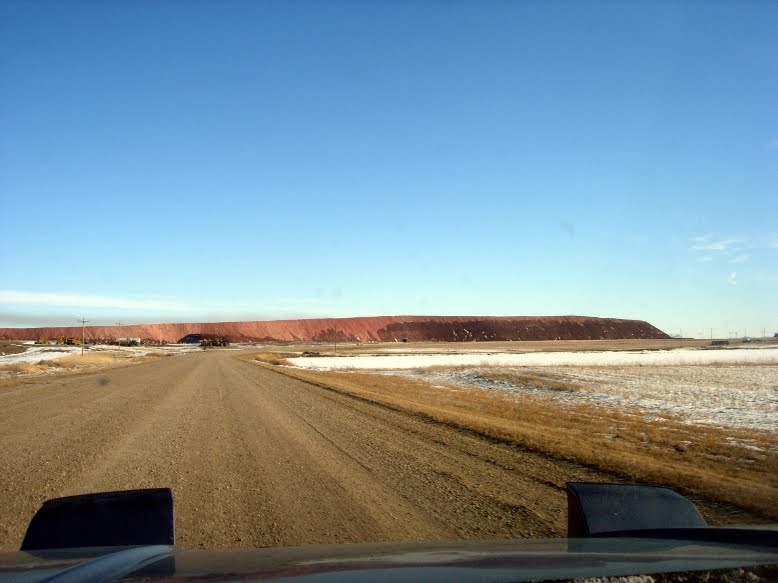
Saskatoon is a city at an arbitrary location. There is no confluence of rivers, shore of a Great Lake, ocean coast, valley opening up from the hills, or any other obvious natural terrain feature to justify a trading post developing into a town and then into a city. What is here is the railroad. Saskatoon houses some large rail yards, and the city more-or-less owes its existence to the subtle grades across the landscape that railroad planners, nearly alone among people, pay attention to. So I decided to explore a bit along those lines.A major rail route out of Saskatoon runs to the east by southeast; part of this track runs near my friends' house on the southern edge of town. It parallels Highway 16 for hundreds of kilometres, though the more-recent highway tends to stay a dozen or so kilometres from the tracks. There are rural, secondary and tertiary highways that stay closer to the tracks for portions of its length; the easiest access for me to one of these smaller roads was through the town of Bradwell.
Rather than follow the road into the tiny town of Bradwell, I crossed the tracks then looped back along a dirt road that runs parallel to the tracks for a few hundred metres before re-crossing the tracks and running between the town's grain elevator and the railroad. Presumably this road exists because of that grain elevator. Unfortunately I didn't think to snap a picture as I cruised slowly under the loading arm hanging out from the elevator.
The main road that had been pavement going through Bradwell became dirt/gravel soon after, but at this time of year and in these conditions, a gravel road is actually easier to drive on than pavement. With little snow, frequent strong winds to blow snow away, and low temperatures, the gravel is frozen in place, and smooth ice cannot form. On pavement, snow compressed by passing vehicles doesn't blow away, and often forms quite slick ice patches.
I have heard it said that the toxic algal blooms that frequently cause trouble on the Gulf of Mexico coast are the fault of Saskatchewan, because this province exports so much potash fertilizer to the vast agricultural fields of the American mid-west. Runoff from these farms fills the Mississippi river with huge concentrations of industrial-agricultural chemicals, which end up in the shallow near-shore waters of the northern Gulf of Mexico and cause the blooms. Saskatchewan's potash mines are not a key contributor to this: potash is K2CO3, and marine algae are limited neither by potassium nor carbonate supply (ocean water contains plenty of both); the blooms are triggered by the relaxation of the limits on their supply of phosphorus and nitrogen.
Beyond the mine lies the town of Allan, which I skirted around on Provincial Highway 763. This road passes through or near to a number of towns with unusual names. After Allan, I passed Zelma, Young, and Xena, before turning north at the town of Watrous. I was driving down the alphabetic line and didn't even know it! Look closely at a map of Saskatchewan, and you'll see the names of towns starting with sequential letters of the alphabet. From Bradwell to Watrous I crossed the end-points of two adjacent lines.
Continuing north on provincial highway 365, I reached the tiny resort town of Manitou Beach. Saskatchewan contains a large number of lakes sitting in isolated watersheds - liquid water has no way to reach the sea if it lands inside these basins. The resulting lakes and wetlands inside these watersheds vary in their chemical and biological characteristics - some are essentially freshwater, but many are saline to different degrees, and some contain Artemia spp. brine shrimp populations. Little Manitou lake is saltier than the ocean, and the resort here grew up from legends of medical benefits associated with bathing in or drinking the waters. There's very little such activity in winter, though.
Eventually I met up with Highway 16, and decided to follow it back home to Saskatoon. It's a pretty boring road.
Monday, May 25, 2009
Book Club: Dragonfly
An Epic Adventure of Survival in Outer Space
NASA and the Crisis Aboard Mir
Bryan Burrough
HarperCollins, New York, USA
This book took me a very long time to read. I’m not sure when I started it, but it was certainly more than a year ago. I’m not sure why, exactly, I took so long to read 519 pages about space exploration, a topic close to my heart, but there it is.
Rather than speculate about my own surprisingly slow reading pace, there’s one issue that this book presents to me obliquely that I’d like to discuss. I don’t normally talk much about my personal philosophy here, but I have to in order to discuss this book. I’m an atheist, and a philosophical materialist. This does not mean I’m in it for the possessions, rather I have yet to see anything to convince me that there is “something more”. I never think of anything about my life in a “spiritual” context; indeed I don’t actually know what that word means. I am not emotionless, but I do not subscribe to any ideas concerning supernatural or paranormal influence on my thoughts or feelings. In short, I completely agree with the statement “that which cannot be measured does not exist”.
That bit of personal background is necessary, I think, for my description of an issue raised in my mind by Dragonfly. Before I get to that, though, I think I need to tell you about the events described in the book. Dragonfly is an extremely detailed, very thoroughly researched investigation into the events that occurred aboard and around the Mir space station in the summer of 1997.
To oversimplify the situation, at that time the USA needed more experience with long-term space flight and space stations because of the upcoming International Space Station (ISS), and Russia had that experience in the form of continuous operation of Mir for several years, and was in need of both foreign good-will and hard currency. A partnership was drawn up, and American astronauts visited Mir for several months at a time over a period of a couple of years.
Unfortunately, a number of serious crises afflicted the station, culminating in a very serious on-board fire and a damaging collision with an unmanned resupply vessel a few months later. As I said, this book provides an amazingly detailed account of these and other events, so I won’t describe them more than that. These events had a range of effects on the many people involved, including a dramatic change in the relationship between NASA and the Russian Space Agency; this change was mostly positive, with greater trust and cooperation from 1998 onwards.
The issue that struck me most about the complex story presented here is never explicitly mentioned in the book. Not once. But it struck me as central to the story of unfortunate decisions, poor communications, and conflicting personalities. Magical thinking pervades the entire story.
Astronauts, engineers, and the vast army of ground controllers, doctors, administrators and so forth who are employed in space are much better educated than the general public. Yet within NASA and the Russian Space Agency, superstition and fuzzy-headed woo seems shockingly abundant. Throughout this book, mention is made of the prevalence of magical thinking within these institutions, but never is there any suggestion that this is odd, and frankly, dangerous among people who make life-and-death, hundred-million-dollar decisions on a daily basis.
The examples from this book I can think of off the top of my head include the photograph of the cosmonauts a few days before their launch, apparently seriously considering the advice of a local astrologer. Not astronomer, a professional group of scientists one would expect to have at least some contact with spacefarers, but an astrologer. At one point late in the tale, one cosmonaut must be laboriously persuaded to accept experimental apparatus aboard the station, because it includes a study of cancer cells, and he is afraid this is both a bad omen, and a carcinogenic risk to himself. Did he drop out of high school?
Among the NASA astronauts, there are several cliques. Besides the alarming implications for necessary teamwork and solid professional relationships among people living in an extreme environment and close quarters, one of the cliques is described simply as “the Christians”. Wait, what? There are a large number of astronauts whose primary description is derived from their religion? What about the astronauts whose primary description is derived from their training, from their specialization? Why are astronauts not referred to as being doctors, engineers, scientists, pilots?
Even as we struggle to go beyond this tiny planet, we carry our baggage of superstition and foolishness with us. I am disappointed.
Sunday, August 17, 2008
Book Club: Coast Guard to the Rescue
Karl Baarslag, 1936
Farrar & Rinehart, New York
I was looking for a way to kill 10-minute blocks of time after meals and before fieldwork bouts each day, and the Churchill Northern Studies Centre (CNSC) maintains a small “reading room” across the hall from the cafeteria. Most of the books on the shelves deal with various aspects of the North, such as wilderness survival manuals, biographies of Arctic explorers, or descriptions of legal proceedings and legislation of particular relevance to northern Canada. At first glance, this book appears to have little to do with Churchill, Manitoba, as it is about the history and exploits of the United States Coast Guard, an organization with little presence here.
This book fit my desires perfectly – it’s a series of chapters further subdivided into vignettes each of about 2 or 3 pages. After breakfast the other day, for example, I read two of these vignettes while some of my colleagues washed dishes, before heading out to the intertidal to collect marine invertebrates.
I did not realize the age of the book when I first started reading it. I didn’t check the copyright date until I first read a passage about the “recent” sinking of the Titanic. Later references to “the World War” and the very recent repeal of Prohibition confirmed this book had not been edited since 1937. Not only did I find a book full of interesting little anecdotes to read while drinking a cup of coffee, I also found a book that acts as a window into the past of 70 years ago.
Once I’d realized how old this book is, the reading became that much more enjoyable, as references to the difficulties involved in some rescue operations take on new meaning when these events are taking place before the advent of maritime radar, or universal voice-radio on all ships and boats. The cutting edge of marine lifesaving technology in 1936 was the flying lifeboats operated in modest numbers by the U.S.G.C. The author describes with glowing pride the fleet and typical operations of these aircraft, including sections on how amazing and impressive it is to be able to transport an injured person from a ship off the coast to a hospital in merely 6 to 12 hours. Much of that time is consumed preparing for the flight from a shore base, taking off, and landing near a ship at sea. While modern helicopters may not actually be any faster during level flight than those old flying boats, my understanding is that a great many improvements have been made in reducing the readiness time of rescue operations. Prior to the development of lifesaving marine aviation, of course, there was simply no hope for a critically injured person aboard a ship at sea that lacked full medical facilities.
Other unintentional historical notes I pulled from the book included pre-World War II attitudes towards women. At several places in the book, the presence of a woman on board a stricken ship is used to render a situation even more gripping and desperate, with participants in a rescue of the 1880’s on the Great Lakes reacting with great consternation at the news of a grounded ship’s cook’s gender. The occasional reference to public attitudes and politics of the Prohibition era was also very interesting; I hadn’t realized how divisive in American politics that constitutional amendment had been. The author presents in oblique ways a hint that rather than being a case of temporary majority opinion, the enactment of Prohibition in the U.S.A. was more widely viewed as a temporary and surprising gain of political power by “dry fanatics” in control of the legislative branch of government. I’m sure there are parallels with current American political events.
The other nice thing about this book is its length – I finished it on my last full day in Churchill, having read it for perhaps 25 minutes in total each day on average, spread out into 3 or 4 short blocks of reading and caffeinating.
Monday, March 03, 2008
30
This will not be a long and possibly maudlin retrospective, as I am too busy currently preparing for my PhD Qualifying exams which will happen in two weeks (March 18). These are a decidely non-trivial landmark in my academic career, and preparing for them has consumed a great deal of my time lately. Don't expect a sudden upsurge in activity around here in late March, either, as I'll still be pretty busy with lots of other PhD-type stuff.
Rather than blather on about my life or whatnot, I'll make two unrelated observations:
1. On my father's 30th birthday, he had completed his PhD several years earlier, was married, and had two children (I was the second). I have acheived none of those things (though, to be honest, I have no intention of achieving that last one, much as I appreciate that my parents did).
2. According to XKCD (which is never wrong about anything, evar!), the minimum age of a person I can date is now 22. I'll leave it as an exercise for the reader determining the significance, if any, of this fact.
Sunday, September 09, 2007
Book Club: Winter
WinterLen Deighton, 1987
Grafton, London
Winter is not the next book I read after I finished Blue Mars; just the next book I've actually felt compelled to discuss here. Sorry it's been so long since my last book club, but this just fits the general pattern of blog-post neglect you may have noticed here over the last two months or so.
For some context, the books I read since I finished Blue Mars are (in rough order): Fahrenheit 451 by Ray Bradbury, Clear and Present Danger by Tom Clancy, Starfish by Peter Watts, and 2020 Vision edited by Jerry Pournelle. Of those, I may yet put together some of my thoughts here for any or all, but I just finished Winter and there are a couple of things about it I wanted to write down. Feel free to ignore my written ramblings in any case.
Finding the cover picture I used was really difficult, because multiple different printings of this book all had different covers, and the most popular one on the web is much more recent; it looks like this. One hardcover edition is similar to the paperback I've got, but it's not exactly the same so I ended up taking myself the rather crappy photo you see at the top. Sorry for the low quality of the image; I need to work out a better way to photograph books than my current hold-it-up-and-snap method.
Anyway, my edition's cover and lots of websites refer to this book by the prolific author as "His Epic Novel"; in my edition's case in bright red large-font capitals. The sense of the word "epic" here is, I think, that it's a long and involved story that delves deep into a small number of characters, not the older sense of a story distinctly different in narrative structure than a novel - that would likely be oxymoronic. The two central characters of the book are two brothers, sons of a wealthy Berlin banker named Harald Winter; both sons were born just at the end of the 19th century, four years apart. It's a good read, and lives up to the hype I found on-line that describes the comprehensive research and meticulous attention to detail that went into crafting this story - one really does get a sense of place for the well-scrutinized period in Germany when the Nazis rose to power.
The most interesting thing about the book to me was the teaser prologue. The very first lines of prose in this book describe a lawyer named "Winter", no first name, who has become the defense counsel for an old colleague, a Nazi party official tried at Nuremburg after the war. As I was reading the rest of the book I was constantly trying to predict which of the two brothers would be that lawyer, and which would be the briefly-mentioned brother working as part of the prosecution for the Americans. I figured it out for sure about 3/4 of the way through; I was confident of my guess earlier, perhaps 2/3 through.
Having admitted that, I now expect that anyone else reading this book would turn to me and claim to have figured it out by page 100 of this 530 page novel. I make this prediction based on my experience with movies. Without fail, any movie with a surprise or hidden ending, or a twist, is always described to me as being "too obvious" and that the person describing the movie had it figured out five minutes in. BULLSHIT. I really wish people would stop pulling this crap, and telling me they knew who Keyzer Soze was after the first 10 minutes of The Usual Suspects, or that they predicted all along that Darth Vader was Anakin Skywalker. So if you read Winter, please don't come to me (or come here) later and tell me you knew it was Paul or you knew it was Peter all along.
Tuesday, May 29, 2007
Book Club: In Search of Schrödinger's Cat
Quantum physics and reality
John Gribbin, 1984
Bantam, New York
This is an excellent book for someone, like me, who doesn't know anything about quantum theory except some vague thoughts about probability, radioactive decay, "tunnelling" and other haphazardly-acquired ideas. Before reading this book, I knew about 'spin' as a property of electrons and other subatomic particles, and I knew that the entire field of quantum mechanics was basically invented by Einstein in a couple of papers in the first decade of the 20th century. But now, I feel like I know less, but have a better understanding of a lot more. If that makes any sense. If it doesn't, I'm thinking in terms of the certainty of scientific knowledge (or lack thereof).
I didn't take notes while reading this book; perhaps I should have. I know there are several points in the book I wanted to put here, but I can't remember them. I do know that the explanation of 'spin' given here is the best I've yet seen, and the repeated injunctions to stop trying to come up with a familiar-world analogy for the world of the very small because it just won't work.
The book is written in historical order - the earliest theorizing and discoveries relevant to quantum physics are presented in earlier chapters, then later work that built on this foundation. Einstein isn't the first person to appear in this book, as there was quite a body of observational evidence that had to be accumulated first, particularly dealing with the discovery of radioactivity and such phenomena as X-rays. The double-slit experiment occupies centre stage, as so it should - at least, I have been convinced of the double-slit experiment's central importance to modern physics by the excellent descriptions (there are more than one) in here.
I have seen the opinion voiced that for science writers for a non-scientist audience, formulae are death. There's a half-joking formula floating around that suggests every mathematical formula written in a book cuts the readership by a factor of ten. There are several formulae here, but they're all of the relatively easy, fairly basic form without too many parameters, and they're always associated with a good, clear diagram that helps to explain what the math is trying to say.
Perhaps my only complaint about this book, besides the fact that my copy has a weak binding and is falling apart, is the footnoting. I'm used to reading books where the footnotes (or endnotes as they may be) are typically further elaboration of a point, often in the form of a short anecdote about a contrasting opinion or historical quirk of the situation. There are a handful of footnotes of that type in this book, but the overwhelming majority are citations. Just a citation for a quote or particular factoid. For example, the footnote on the bottom of page 74, for an asterix appearing after a quote from Bohr about Heisenberg's work, is just "Quoted in Mehra and Rechenberg, volume 1 page 357". I saw that asterix and I was hoping for an elaboration, or maybe another quote from Bohr from years after the first, or a quoted reply by Heisenberg to what Bohr had said, or something, so I was a little disappointed when I just saw a citation. I think citations are important, and I'm glad that John Gribbin shows such academic rigour, but it would have been nice to get some non-bibliographical information.