Showing posts with label Organisms. Show all posts

Sunday, January 31, 2016

Betty Crocker Cookbook #28: Pecan-Crusted Fish Fillets (pg. 243) - 160127

It took me a while to make up my mind regarding the fish to purchase when I was at the grocery store this week. Most fresh fish is pretty expensive around here, but I settled on Basa fillets (boneless and skinless) because they seemed suitable and were not nearly as pricey as (for example) the tilapia or the Atlantic cod. One aspect of this project I'm really looking forward to is the fish and shellfish chapter, because I eat very little fish normally. Aside from the occasional bit of tuna, I almost never eat anything from the sea or freshwater.

The reason it took me a long time to choose the basa was mainly because it is not included on the list of fishes on page 242 of Betty Crocker - there's a helpful table for classifying fish. Mostly it comes down to the texture of the meat. Some recipes call for "medium-firm texture", others for "delicate to medium" or "firm". I gather these differences would affect cooking times and temperatures, and the ways one might handle the fish pieces during cooking. A bit of googling reveals that basa is southeast-Asian catfish, farmed in the Mekong river. There's actually a fair bit of discussion regarding basa online, and I'm not sure I'll buy it a second time. This is part of the reason I so rarely eat fish: I don't want to contribute to an industry that has so many harmful environmental impacts across so many different ecosystems.

No photo this time, because somehow it completely slipped my mind. Chopping up the pecans took a bit of time, and only about half of them stuck to the egg-dipped fish fillets. So some of the pecans ended up fried directly in the pan, which was fine, it's not like nuts go soft in a frying pan or anything.

Wednesday, January 28, 2015

Book Club: Mind of the Raven

Mind of the Raven
Investigations and Adventures with Wolf-Birds
Bernd Heinrich
Harper Perennial
New York

I picked up this book from a discount bin at a local bookstore; I like ravens (Corvus corax) and I wanted to learn more about them. This book provides lovely information about raven life-history and behaviour, so I succeeded there. Book Club entries here are not supposed to be book reviews, I will say I enjoyed this book and I would recommend it.

The author is a professor emeritus of biology at the University of Vermont; he is an ecologist by training, with some specialization in ornithology though I don't think he would describe himself as an ornithologist; his interests are too broad for one vertebrate class. At several points in this book I was struck by the evidence of his career as a scientist, such as when he talks about his model of raven behaviour being congruent with the observational data, and his frequent references to the trouble he's had getting some papers published. I have been criticised in the past for not providing a summary of my project or proposal that was written for an "interested non-scientist" or having too much jargon in my attempt at such a piece. It's very difficult to write about science for a non-specialist audience without coming across as condescending or dumbing it down too much. I don't know if Dr. Heinrich succeeds, because I have enough training in ecology to skip right past the words and phrases that presumably lead non-scientists to pause and scratch their heads (or roll their eyes). 

I enjoyed this book, so I think I'll try again to find some more science writing that I can read and evaluate for a different audience (i.e., different from me).

Friday, August 26, 2011

Friday Fish: Hiodon alosoides

The goldeye, one of two species of "mooneyes", family Hiodontidae, endemic but widespread in the freshwaters of central, northern North America. Presumably, there are some near me here in Saskatchewan.

Image from the Smithsonian

Friday, August 12, 2011

Friday Fish: Pegasus volitans

Slender sea moth or sea robin (Pegasus volitans)

A seamoth, family Pegasidae, order Pegasiformes. This is a very small and very strange family; my Fishes of the World, 2nd Edition (Nelson, 1984) describes a single genus, with five species, and only this family in the order. It also describes the family as
"Body oddly shaped (broad and depressed), encased in bony plates; mouth small and toothless, beneath a long flattened rostrum (formed by fused nasals), with an unusual mechanism for protrusion of the jaws...
Image from WildSingapore's flickr page, here.

Friday, August 05, 2011

Friday Fish: Emblemaria hypacanthus

The Gulf Signal-Blenny, a member of the family Chaenopsidae, of the order Perciformes.

Image from the Encyclopedia of Life.

Friday, July 29, 2011

Friday Fish: Albula vulpes

bonefish Albula vulpes
I have reverted to my old method of choosing a Friday Fish: open my fish taxonomy book to a random page, and read about orders and families until a genus or species name appears. This is the very widespread, tropical bonefish, though it may be a species complex with several cryptic species.

Photo from and taken by (Flickr photostream of) Brian Gratwicke.

Friday, July 22, 2011

Friday Fish: Gymnothorax funebris

The Green Moray, a member of the species-rich family Muraenidae, order Anguiliformes (the true eels). This photo was sent to me by Necator - thank you very much!

Friday, June 24, 2011

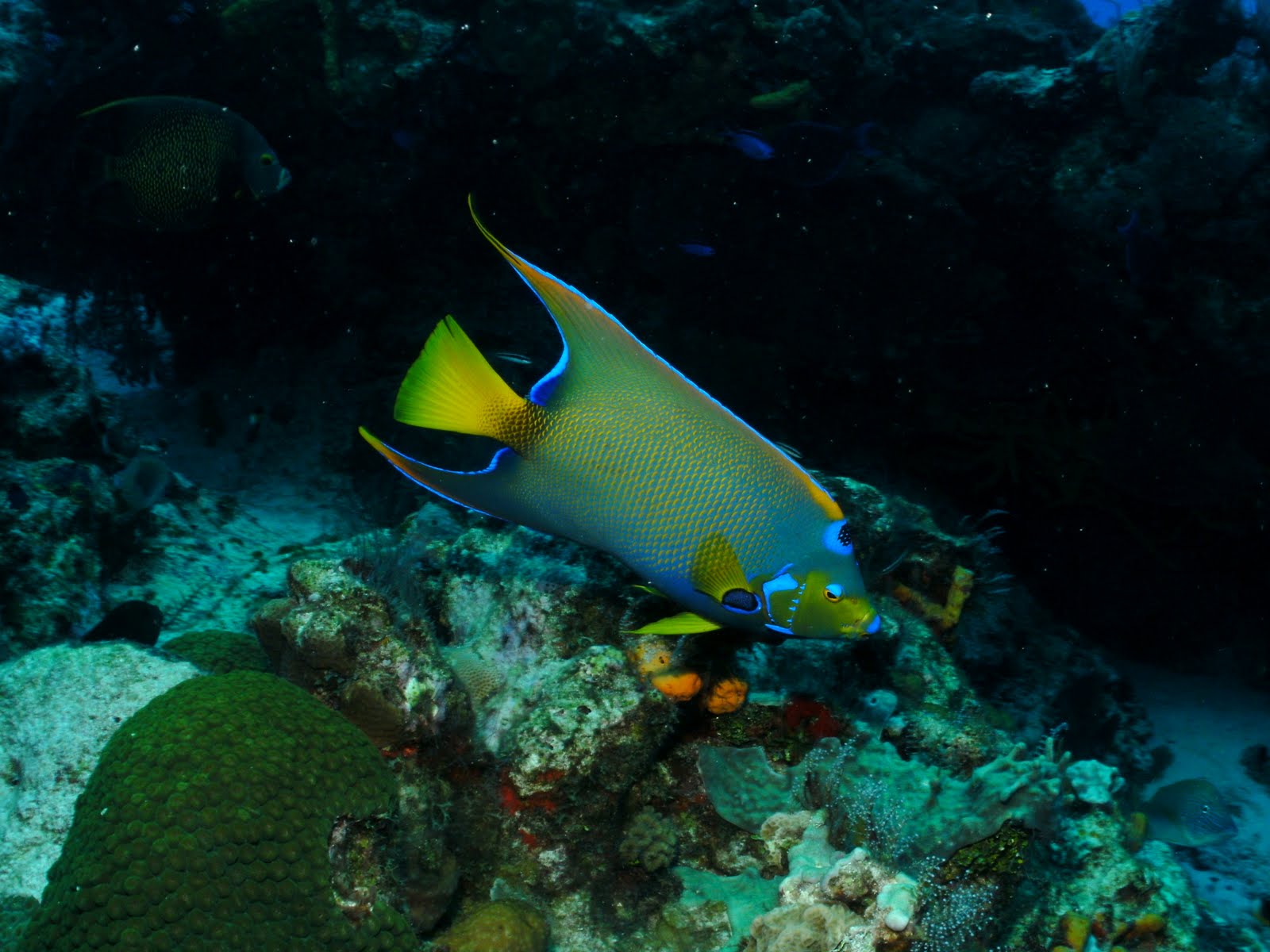
Friday Fish: Holacanthus ciliaris

Necator sent me a zip file with pictures from his adventures. This one looked the easiest to identify, and I'm pretty confident that this is indeed the Queen Angelfish. I think this picture is better than several on Fishbase. Nicely done Necator, and thanks for sending it to me!

Friday, June 03, 2011

Friday Fish: Galeorhinus galeus

The Tope Shark, a smaller elasmobranch with a wide distribution in the Atlantic, Indian, and Pacific oceans. Picture from here (Hannah, am I close?).

Friday, May 20, 2011

Friday Fish: Holocentrus rufus

A Squirrelfish, Family Holocentridae, subfamily Holocentrinae. Picture from here.


Edit: Reader and all-around excellent person Necator sent me a picture of this species he took while on vacation! Hurray! If anybody else reading this blog feels like sending me fish pictures I'm always happy to get them.

Saturday, May 07, 2011

Friday Fish: Calamoichthys calabaricus

This is one of the world's only surviving bichirs, an order of fishes (Polypteriformes) lumped in with some other weirdos (such as last week's coelocanth) that are not the ray-finned fishes that most people are more familiar with. In ichthyology and evolutionary-history classes, they always seem to get listed with the other oddballs next to or after the "main event" fishes, which in practice always seems to be composed primarily of the Perciformes. That's a rant for another day, if ever. There appears to have been some recent systematic work on the bichirs, as the alternate genus name Erpetoichthys also shows up.

Picture from here.

Friday, April 29, 2011

Friday Fish: Latimeria chalumnae

The Coelocanth. The most famous "living fossil", the lobe-finned fish that lives in the sea (rather than muddy and prone to dehydration tropical fresh waters), and has accidentally been associated with South Africa's former racist government. They give birth to live young, which should provide a stumble for any wishing to apply the term "primitive" to these famous-but-poorly studied fish.

Photo from here: http://marinebio.org/species.asp?id=54

Friday, April 15, 2011

Friday Fish: Hysterocarpus traski


Hysterocarpus traski is listed in the 2nd edition of Fishes of the World (Nelson, 1984) as the exceptional species in the family Embiotocidae, for having 15-19 dorsal spines, rather than the 6-11 of the other species in this family, also known as the surfperches.

Like the guppies I used to study, these fish are viviparous, they give birth to live young, and the male's anal fin is modified as an intromitent organ (i.e. a wang). At least according to this book, with this section apparently based on Tarp (1952), the family is restricted to the coastal North Pacific (rarely in fresh water). I know I've met members of this family, though probably not this species (judging from the picture), when scuba diving around Vancouver Island and Howe Sound near the city of Vancouver.

Tarp, F.H. 1952. A revision of the family Embiotocidae (the surfperches). Fish Bull. Calif Dep. Fish Game 88: 99 pp.

Photo from here.

Wednesday, January 06, 2010

Update!

Sorry I haven't been updating around here. To let everyone know I haven't abandoned the blog, here is the result of a quiz.


How long could you survive chained to a bunk bed with a velociraptor?

Created by Oatmeal


Actual updates to follow, when I get sufficiently motivated. Soon, I expect.

Monday, November 23, 2009

Dr. Rob E. Roughley

I received an email today, informing me that a man I was proud to call a colleague and fellow traveller in this business of science has died. Professor R. E. Roughley was not someone I knew well, but I did benefit from knowing him as much as I did, and I am saddened by his death.

Rob was an expert on water beetles, particularly of the family Dytscidae, which is a group I worked on for the time I was based in Guelph. Rob provided excellent advice on methods of capturing, identifying, and generally working on these beetles and other small animals commonly found in the numerous small lakes, ponds, streams, and rivers of North America. His advice was always useful, and I can think of many instances where his help turned my fieldwork, collecting aquatic animals, from hopeless to bountiful.

We shared a glass or two of whiskey while we were both in Churchill in the summer of 2007. I raise my glass now to his fond memory. Goodbye Professor Roughley, you will be missed.

Tuesday, October 06, 2009

Solo Walkabout

090810

Two days ago, on August 8, I had a whole day in front of me and nothing pressing in need of doing. I’d just finished helping Katherine with her morning 15N injections, and at about 9:30am I decided I’d like to do a little exploring in the Alexandra Fjord area. It was a clear day, without too much wind, so I packed a lunch and some cold-weather gear (just in case) and set off to see the lower slopes of the Dome and the west side of the valley.

My goal for the day’s adventure, a traverse at near-constant altitude across the east slope of the Dome, from south to north. My route is indicated by the red line.

Rather than cross any rivers by myself, a dangerous and uncomfortable task, I planned to walk diagonally south and west across the valley away from base camp until reaching the north-flowing small river that supplies are our drinking water. This would be the same river that Katherine and I crossed on our previous excursion. Then I would follow the river upstream as it curves to the south and east, ascend the Dome to the first major bench, and traverse along the Dome at this height until I felt like coming back down and returning to camp.

The north half of the drinking-water river, viewed from a spot not far from where Katherine and I crossed it nearly 2 weeks ago.

There has been little erosion in the 12 days since I last passed this way. The bootprint on the left is from that previous trip, on the right freshly-formed.

The cottongrass (Eriophorum sp.) was in full display.

I nearly stumbled into this tiny side-channel of the river.

Moving southwest not far from the river, I crossed a broad, nearly-level plain littered with large glacial erratics – boulders deposited by a retreating glacier. There are lots and lots of such erratics all over northern North America, remnants of the last great ice sheets some 15000 years ago. One such large erratic is the basis for the name of a brewery in Calgary, Alberta. The difference here on Ellesmere Island is that the glacier that left these erratics behind is still very much in place, and has a name, in this case the Twin glacier.

An antler was resting on this multi-tonne behemoth of an erratic, and the white was visible from much further away than the distinctive shape.

The view from atop the erratic in the previous photo, looking north back towards base camp and the fjord.

The terrain forced me closer to the river, and for a while I was following my companions footprints, retrograde. Here is a footprint made by one of my companions when they descended from Katherine and my camp on the Dome on July 9, a month ago.

The north half of the river emerges from a canyon known as “Helm’s Deep”, descending swiftly through a channel of boulders and steep walls. I had no desire to chance the river’s current, but I wanted to see into the canyon, so I climbed a short distance alongside the rushing river before I decided "enough of this!" and scrambled up the north wall of the canyon. That scramble was probably the most tricky thing I did that day, a careful half-crawl up a steep and crumbly slope of granite boulders, soft gravel, and loose sandy soil.

The view to the south from the rocky point above the north wall of the Helm’s Deep canyon.

Another view from the same spot, looking northeast.

My altitude where I paused to take the above photos and drink my coffee was 186 metres, according to my GPS. This number would appear again and again on my GPS screen as I traversed the bench of mixed granite and dolomite that forms this part of the Dome. I was trying to stay at roughly the same altitude, periodically turning on and checking my GPS, and while I strayed a bit, up to about 200m, down to about 170, for some reason by far the most common reading was exactly 186m.

The view of base camp from the bench. The “Willow” and “Wet Sedge Meadow” OTCs are visible below and to the left of base camp.

“Cassiope” OTCs.

“Dryas” OTCs.

“Vaccinium / Fert” OTCs.

The terrain of the bench was a mix of polar desert and wetter patches of tundra. The differences between the two ecosystems are very apparent when they are so closely juxtaposed.

Polar desert.

Tundra, at least by my estimation.

I continued along the bench until I got hungry, then stopped for lunch on a prominent boulder or protrusion of bedrock. I like having a spectacular view during my meals.

The view from near my lunch spot towards base camp. The light-coloured pile of rubble on the left partially covers the granite block I sat upon to eat.

I continued around to the north slope of the Dome, where the structure gradually changes from a dolomite-dominated series of benches to a granite-dominated series of vertically-running channels and shallow, steeply-pitched canyons. This granite structure is much more difficult to traverse laterally, besides which I thought I should be heading back towards camp because I was scheduled to make dinner that evening.

The view north from the north slope of the Dome. Several of the icebergs had large melt-pools on them.

I was struck (not literally) by this precariously-balanced boulder on my way down the north slope.

The boulders here were very loose and unstable, so I wasn’t able to get as close to this boulder as I’d like.

I did get close enough to include my hand for scale.

Below the north slope of the Dome there is a narrow strip of wet and boggy tundra, covered with a mix of sedges and black mosses. This is apparently the home of a couple of pairs of parasitic jaegers (Stercorarius parasiticus), and I met one. I spent some time verbally berating it, thinking it was a juvenile with low muscular endurance, because it repeatedly flew only a few metres, then landed, then flapped around and took off for another short flight. On later reflection, it’s more likely this was an adult faking injury to lure me away from a nest. This late in the season it seems improbable that there are any non-flying juveniles or eggs around, but this behaviour is probably an instinctive response to a potential predator.

The fake-injured jaeger I followed and verbally abused for a bit.

I walked along the shoreline to the west, up towards the top of the fjord, and freaked myself out a little bit with some bearanoia: I was carrying no deterrents, not even “bear banger” firecrackers, and I knew I was in primo polar bear habitat. Fortunately, I encountered no bears.

It was very quiet, and there was little wind, perfect conditions for sound to travel far. I could hear a marine mammal periodically surfacing, so I walked down a short way and saw a pair of walruses (Odobenus rosmarus) diving and surfacing.

A cropped photo taken through my binoculars of the pair of walruses. They sit low in the water even when resting on the surface, so the distinctive tusks were only rarely visible at all, and then only the uppermost parts.

On my way back to base camp, I must have passed right through two jaeger territories, as I was dive-bombed repeatedly by 4 different birds, including the fake-injured dark-coloured individual I’d previously yelled at. Turnabout is fair play, I suppose.


VIDEO: Jaeger attack 1


VIDEO: Jaeger attack 2

Their attacks were quite spectacular, and I did get a bit of an adrenaline charge as these quite large birds (larger than a crow, similar to an average sea gull) wheeled in the sun and feinted towards my head. My camera was rapidly running out of battery power, so I tried to quickly escape the jaegers, but their territories are rather large and I was attacked off-and-on for about 10 minutes.

I got back to camp by about 3:00pm, more than enough time to get started on dinner. Overall, a very satisfying jaunt around the western side of the Alexandra Fjord lowlands.

Saturday, October 03, 2009

Wildlife

090806

This morning I completed my last bit of work for this field season, after finishing my last bit of field work yesterday morning. An hour of data-entry and proofing this morning, and I’m done work until September. It’s a pretty nice feeling, not surprisingly.

Everyone else here still has much to do, of course, so I’ll be helping out where I can; I expect to do a fair bit of cooking and cleaning over the next 10 days or so. Katherine’s work in particular continues for 6 more early mornings, and I’ll be able to assist her with some of her other tasks as well.

Not a great deal has happened in the last few days, but I did see a couple of interesting things.

I tracked a bumblebee (Bombus sp.) back to her underground home while running the FTIR at the Cassiope site the other day. She disappeared under this little bit of Cassiope tetragona a couple of times, so I think this is where her babies are sequestered. Rather than an act of pleasant maternal care, I might have stumbled upon a grim struggle of life-and-death, however – I later saw a smaller bumblebee nearby. There are 2 species of Bombus here, and the larger one is a nest parasite of the smaller, so what I may have seen was an act of parasitism, as a Bombus hyperboreus took over the nest of a hapless Bombus polaris. Still maternal care, but with a dark zero-sum-game aspect to it.

I saw a quite large bumblebee while I was running my soil gas probes a couple of days ago, and I took a video of her crawling around on my equipment.


Yesterday morning a group of 5 possibly juvenile walruses (Odobenus rosmarus) were feeding and roaming around in the shallows very close to shore below base camp, and the tide was very low. This allowed us to get very close to these animals, animals that I consider the ne plus ultra of proof that one is in the High Arctic, at least at the same level as seeing narwals (Monodon monoceros).

Another shot of the walruses.

I also took a video of the walruses


The tide lifts and drops icebergs on the shore; at the second low tide of yesterday in the afternoon, I exposed pretty much an entire roll of film on these few, mainly because of the interesting light, shadows, shapes, and colours in and around the ice. I’ll post those picture after I get my film developed.

My watch died sometime during last night. The timing is fortunate, as I no longer need it for my fieldwork. RIP, faithful timekeeper.


After I wrote the above, at around 3:00 pm, a group of kayakers arrived. This is a tour group run through a private company whose name I have forgotten. This kind of High Arctic tourism is not cheap – the copilot told one of my companions that the total price tag for all 11 passengers was in the order of $110000, or about $10000 per tourist.

There was some kerfuffle because they were transporting some equipment back to Resolute, and their gear was partly mixed with ours, but this was sorted out without too much difficulty. I know perhaps the least of anyone about what belongs to whom, so I stayed out of that discussion.

As per their usual routine (I gather), the kayakers set up their tents close to our outhose. This was annoying to my companions, but it really didn’t bother me any. Most of the group took off in the late afternoon for a bit of a hike – I saw them through my binoculars about ½-way up the Dome – so they really didn’t cause as much disruption as my companions thought they would.

There’s an interesting social dynamic at work here. We (my companions and I) have settled more-or-less into a reasonably stable social situation. There’s plenty of grumbling about such-and-such a person doing something wrong, or not working as hard as another, but it’s pretty minor. The arrival of a group of strangers, who have purposes highly different from our own (work vs. play, bluntly) and are almost entirely much older than us (I was the oldest person here, at 31; these tourists all appear to be retired, and one or two look older than 70) has thrown all of us for a loop. I feel like I have reacted the least to this arrival, but it’s hard to tell. It’s generated some topics for (ranting) discussion, at least. We seem to have become rather hermit-like, to varying extents.

They’re planning to depart for their 10-day tour tomorrow, so the disruption is temporary.

The tents of the kayakers, just below our outhouse (hidden behind our food-shed).

Monday, April 14, 2008

Sexy Snakes

Sorry for the lack of activity around here, I've been pretty busy with PhD stuff (i.e. my life) lately. However, one of the most enjoyable aspects of my PhD is the abundant fieldwork I get to do. With the weather improving steadily around here, I've been out in the University of Guelph Arboretum to collect assorted invertebrates. I need to clear up some methodological questions before my away-from-Guelph field season, which is approaching rapidly.

Anyway, on my way back from clearing my beetle traps I nearly literally stumbled on a tangle of garter snakes (Thamnophis sp.), which I think was a mating tangle (perhaps these are referred to as "mating balls"?). Does anyone know what species these might be? I gather there are lots of colour-pattern variants among species of garter snakes, and I couldn't find a good picture that resembles these guys. There was one larger individual, possibly a female, in the middle of a cluster of perhaps seven or eight individuals, most of whom were smaller. The largest was about a meter long and maybe 2cm diameter, with others down to about 40cm x 1cm. I stood on a small patch of boardwalk and just watched them for about ten minutes, and snapped many pictures. I also recorded a few minutes of video; if I can figure out software issues I'll try to post it to YouTube and to then here. This happened around 12:30 today, so the lighting is pretty boring, just high-in-the-sky bright sunlight on a forest floor covered with rather uniform and drab-coloured dead leaves. I hope the snakes are fairly clear in these pictures.

Some of my favourite pictures:
The large individual coming down from the top of the picture poked around for a bit then joined in the action. A large, dominant male, perhaps?

The mating tangle about five minutes after the previous picture was taken. I moved a few metres on the path to remove that tree shadow from the pictures. Note the cluster of tails - they were moving around, twisting over each other, for most of the time I was watching.

This guy was moving around in the dry leaves on the other side of the path, making quite a bit of noise. I suspect he (she?) could smell or otherwise detect the mating ball, and was looking for the action.

Another individual from the other side of the path, slightly larger than the one in the previous picture. That's the toe of my right boot in the bottom of the picture, these snakes didn't seem to care that I was there.

Wednesday, January 16, 2008

Friday Fish: Lactoria cornuta

By request, the Longhorn Cowfish.
Photo credit here.

Tuesday, January 15, 2008

Friday Fish: Toxotes jaculatrix


The banded archerfish, one of seven species in the genus renowned for their ability to shoot water beyond the surface to knock terrestrial animals from water-overhanging vegetation.


I met a school of these guys during my recent visit to Simon Fraser University. A couple of guys on the aquatics staff showed me around the facilities that I'd never had reason to visit during my studies there, including a large custom-built aquarium, really a small artificial pond, containing about two dozen individuals of this species. They're surprisingly large; adults can apparently reach sizes of 40cm. We placed frozen krill and some live crickets on structures suspended over the pool, and watched the fish shoot them down with uncanny accuracy. Not just accuracy in targetting; they were also very proficient at predicting the impact site of airborne objects, a skill they use to steal food from each other. These are really fascinating fish to watch.


Photo credit here.
I took the picture of the lab, which explains but does not excuse the generally poor quality of the image.