Showing posts with label Travel. Show all posts

Sunday, March 03, 2019

Birthday Retrospective 41

Today is my 41st birthday, and I've been thinking about the last couple of years and how much has happened in my life. A year ago, I was in Québec (the city in the province), and a year before that I was in Waterloo, Ontario. Today, I am in Armidale, NSW, Australia. It's been quite a couple of years!

Being a post-doc is weird; this is something I say fairly often, probably a couple of times per week. I have been a PDF (post-doctoral fellow*) for about four years, and in that time I have done what seems like a pretty broad range of things at work. Besides the frequent moves - this is my fourth post-doc position, and more on that in a moment - I have taken turns working at particular skills that are typically important skills for university professors - and that is my career goal.

* Technically, I am a Fellow now, but my previous positions since my PhD have been "post-doctoral researcher"; the main difference is funding, in that a Fellow is supported by an award or funding from outside of the lab group or PI (primary investigator; a professor). Here at the University of New England, I have a contract and independent funding and my job title is officially a Post-Doctoral Fellow.

My first PDF, at the University of Waterloo, lasted about 2.5 years. In the final half year or so I started seriously looking for my next position, and I was contemplating relaxing my standards for advertised jobs I would apply for from strictly tenure-track to include interesting PDFs. The main busy period for such applications is the fall in Canada, but before I really got into a serious search - with a hard deadline for my position at U Waterloo of October 31, 2017 - I was offered a PDF with a professor I had met several times and already had the beginnings of a working relationship with. My U Waterloo PI was Dr. Maria Strack, and Dr. Line Rochefort at Université Laval had been one of Maria's PhD supervisors, about a decade earlier and they continue to work together. 

I moved to Québec at the end of September 2017, and in the personal chaos I lost track of world events; my first day of work at Laval was the day after Catalan held a referendum to separate from Spain - an event closely watched by many in Québec. My contract at Laval was short-term because Line was at the end of her main Discovery grant and had not yet secured funding for the next five-year period. She was applying for two other major grants in addition to renewing her Discovery, and needed a person to divert attention from her so she could focus on grant-writing ahead of deadlines in October and November. My job was largely to work with Line's students and others as the English-speaker: I was the only native Anglophone in a lab dominated by Québecois but with plenty of other nationalities and languages as well. I learned that I quite enjoy helping ESL scientists with the intricacies of technical writing in English.

The grants Line was applying for included funding for a PDF, and the unwritten agreement was that should any or all of the grants be successful, that position would be mine if I wanted it. The dates we would learn about the success or lack thereof of these grants were in late March, and my 7-month contract at Laval was set to end at the end of April. In late January, as I was struggling to make plans beyond that end-April horizon, other professors I had worked with forwarded a job ad to me, at Laurentian University in Sudbury, Ontario. 

Dr. Nathan Basiliko paid for me to visit Laurentian in late February - about a week after I first spoke with him and other professors at Laurentian - for a large meeting to bring together nearly everybody involved in a large collaborative grant they had been awarded. That was an interesting meeting, and at the end of the two days I agreed to move to Sudbury to work with Nathan. A big part of my decision was the 2-year contract on offer, as well as the opportunity to expand my expertise into different areas of Restoration Ecology.

Sudbury is a fantastic place, and I thoroughly enjoyed living and working there. After only a few months in Sudbury, I was made aware of an opportunity in Australia, to work with people I'd met when I visited Charlie in December, 2017. Dr. Romina Rader and Dr. Susan Wilson were willing to Nominate me for a UNE PDF, with the first application deadline in early July. There's a long story there, but the upshot is we were successful at the first stage, and I was invited to complete a full application with a 5-page proposal to replace the 1-page version in the first application, due in early September. We were successful again at this second stage, and a Skype interview was scheduled for mid-October; I was told I could expect to hear the decision in about a week.

Around 10 days after the interview, I was informed that UNE was offering me the position. This converted November and December into frantic preparations to move around the world. Charlie had joined me in Sudbury and we had to coordinate this massive undertaking while both of us continued to work - me at Laurentian, trying to wrap up what I could before leaving, and her with the lab work and data analysis stemming from her "summer" job in Sudbury. 

Somehow, we accomplished everything, and moved out of our Sudbury home and drove to Calgary just before Christmas, 2018. That is another story of its own. We were granted our Australian visas and booked our flights somewhere between Winnipeg and Regina, and flew without further drama on January 8th, and over the International Date Line on January 9th, consigning that day to the Time Vortex and landing on the 10th.

Australia has been excellent and wonderful so far, and promises to continue to be so. I baked myself a Birthday Cake today and both Charlie and I have been relaxing and taking it pretty easy all day. On Charlie's suggestion, my Sunday Drives - restarted after a long hiatus in Ontario and Alberta - have become "Sunderday" Drives, a term coined by a good friend of Charlie's in Sudbury. The Sunday Drives were never tightly linked to any particular day of the week, but the move to Saturdays (three such drives have been completed so far) flips the feelings of the two weekend days. Previously, Saturdays often became unpleasant errands-and-chores days, with long hours spent shopping for non-exciting, necessary things and little time to maintain our home with such tasks as laundry or general tidying-up. Now, Saturday mornings are given to shopping for furniture and other necessary things (shops, especially thrift stores, are open limited hours on Saturdays, often closing shortly after noon, and are largely closed entirely on Sundays), with our departure for more fun driving and sight-seeing happening after lunch. This makes Sunday a wide-open day where we can each decide to accomplish as much or as little as we like. Today, for example, I hung an Art on the wall, and baked the afore-mentioned cake. I'll make supper and maybe wash some dishes, otherwise the day is filled with far less useful tasks.

I've been trying to get into a habit of photo-editing, with some success, so here is a recent photo.
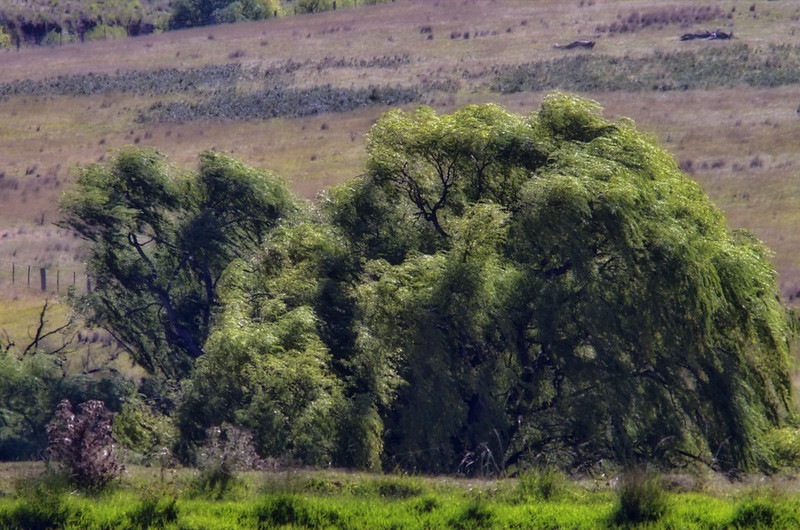
SD 197 Supertele Landscapes 01

Wednesday, December 12, 2018

Moving to Australia

I am deep into moving mode, an emotional state that places a voice inside my head that repeats a few phrases whenever I ponder a wide range of physical objects: "No! Do not buy that!"; "Will this be taken with, packed for storage, sold, or donated?"; "The miniproject you had in mind for this is gone, a dead dream. Let it go.".

This is annoying, I much prefer my normal happy-go-lucky approach to possessions, though this current mood has considerable benefits when it comes to that other major category of possession, money. I would not say I have ever been very good at money, in the sense of avoiding or paying off debts effectively, saving money, and preventing myself from making probably-ill-advised purchases. Between the increased attention I've been paying to my personal finances since late summer and the material needs (i.e., for less material) of my impending trans-Pacific move, my money situation has both clarified and improved. This move to Australia comes with another substantial benefit on this point: a large raise.

As a post-doc in Canada, from my position at the University of Waterloo, through my short half-year at Université Laval, to my current-and-soon-to-end half-year here at Laurentian University in Sudbury, my salary has stayed pretty constant, at about $45 000 / year. My recent improvement in financial self-oversight does not extend far into the past, but I am confident that I can maintain something like my current lifestyle on this level of income. The new position in Australia comes with a salary nearly double that, and while the cost of living will probably be a bit higher, and the move itself represents a significant expense, I anticipate being able to live a slightly more comfortable life there. My current debts would be paid off by mid-to-late 2019 were I to stay here in my current existence, so I anticipate greater chances of success in this goal, even with the currency-conversion and interbank transfer fees I'll incur paying off Canadian debts from Australian income.

So that's one reason why I'm moving. The other, more important reason, is love. Charlie will be starting her PhD in 2019 at the University of New England (as long as certain things go reasonably well, which they mostly have already been doing), and this position for me is in the same laboratory group, so we can STAY TOGETHER! YAY! I have been awarded a University of New England Post-Doctoral Fellowship (UNE PDF), a competitive award that comes with a 3-year contract and considerable support in the form of specific training for professor responsibilities such as effective teaching and applying for outside funding; I am very much looking forward to learning about and practicing both of those.

I think I'll save the application process story for another post, after I arrive in Armidale and take up my new position, just to avoid any public-information weirdnesses - I'll have a chance to clear some things I might want to talk about with the relevant people there.

The third reason I'm moving to Australia is of course ADVENTURE. Ironically, Sudbury is an AMAZING place for EXACTLY the kinds of adventures I am most interested in having. This isn't the canoe capital of Canada - Atikokan, Ontario, a thousand kilometres away, claims that title - but it's a very close second. Greater Sudbury, the coalesced super-municipality of Sudbury plus a large number of suburbs, includes 331 lakes within the borders. My office here looks directly out (I mean, directly - the distance from window to water is about 3 metres) onto Lake Ramsey. Within an hour or two of driving, there are at least half a dozen Provincial Parks with mapped canoe routes, water-access-only campsites, and maintained portages; this includes the jaw-droppingly gorgeous Killarney Provincial Park, which we have managed to visit only once. We'll be back.

I have been spending some of my procrastination time browsing the websites of the State Parks of New South Wales and of Queensland, plus a number of other similar get-out-and-explore Australia websites. The Sunday Drives, which have been dormant here in Sudbury since October (not that I post about them but I do go on them!) will be restarted as soon as possible in Australia. Like Sudbury, Armidale is surrounded by some amazing protected areas that I can't wait to explore.

The move itself has been (and continues to be) a large and seemingly never-ending amount of work. We received the Letter of Offer in late October, so we had about two months to do all things needed for a move like this. Packing, and sorting possessions into take/store/sell/donate has taken much of our time, but some things further from our direct control also require both long times and considerable effort. The visa application, again without talking about it in detail given we have not received it yet, is the obvious example, with published estimates on government websites that our visa may take two months to be processed, though hopefully much less. UNE has hired immigration lawyers to help us, and Visa Lawyers Australia (VLA) have been absolutely wonderful. There's a lot to say in the future about this process, too, but I can say that VLA has been great.

Selling things has been surprisingly effective, I had not expected to make nearly as much money as we have - with more (hopefully) to come - through Facebook Marketplace and eBay. Large things that are not worth shipping, mostly furniture, have gone to local people, organised by Charlie. Smaller things with narrow appeal - mainly my old camera gear - has gone out through eBay. I have bought a bunch of things (including old camera gear) through eBay, but until this move, I had never sold anything. The first to go was my collection of Dragon Magazines, to a few buyers in Ontario and Quebec. Camera stuff has gone to B.C., Alberta, Saskatchewan, Manitoba, Ontario, and Quebec, as well as several American states. In some cases, the cost of shipping exceeds the cost of the item by up to double, but the buyers are willing and the post office is nearby.

That said, if you feel like browsing what I've got up, there are a few more auctions left to run before we drive west (next week), search for "martinb003" on ebay.ca and you'll find me.

Our plan for the move, now well under way, is to drive to Calgary for Christmas, then fly to Armidale by Calgary - Vancouver - Sydney - Armidale. Qantas flies at least once a week on the critical Vancouver - Sydney route, and a few other airlines such as Air Canada also make that trip on most days. We want to avoid stopping in the USA because while it potentially could be less expensive (though not necessarily, as we have seen browsing ticket sellers) there is a large and worrying possibility of all kinds of hassle with US Customs that we would prefer to just dodge. This emotional state comes with strong prioritisation to minimize time and worry requirements in favour of getting stuff done, because there are so very many things to do.

Saturday, November 26, 2016

Book Club: The World Until Yesterday

The World Until Yesterday
Jared Diamond
Penguin, 2013


"What can we learn from traditional societies?" is the subtitle of this book by the author of one of my favourite books of all time, Guns, Germs & Steel. Dr. Diamond is a biologist and geographer employed by the University of California, Los Angeles whose fieldwork has included decades of interactions with members of traditional societies, particularly in Papua New Guinea.

Unlike an anthropological investigation, the subtitle's question is not "learn about traditional societies" and invites us - those of us who don't live in a traditional society - to take what we can from lessons of observation. The book is divided into sections that cover major ways in which traditional societies differ from civilized societies, such as child-rearing practices and settling disputes and conflicts.

The term "civilized" may be controversial and Dr. Diamond mostly avoids using it (I use it in the literal sense; the word means "city builder"). He defines "traditional societies" not in opposition to those of us who live in cities and nation-states with books and processed food and tall social hierarchies, but simply as societies that closely resemble how all people lived until the dawn of agriculture. Hence the main title, in reference to the fact that something like 99% of the time of human existence has included no agriculture and no cities. He repeatedly makes the point that the very broad diversity of traditional societies and how such people accomplish basic human universal tasks represents a natural experiment; we can observe the 'results' of these experiments and gain useful knowledge to improve the organization and daily life of our own societies.

The enormous diversity of traditional societies makes it difficult to draw broad generalizations except by defining the term against non-traditional societies. Dr. Diamond describes a hierarchy or social-development pathway (while reminding the reader that societies can and have moved in the opposite direction) from bands to tribes to chiefdoms to nations, separated by increasing levels of population size, subsistence, political centralization, and social stratification. Most currently-extant traditional societies are very small, qualifying as bands or tribes, because most of the world is owned by nations. The categories grade into each other rather than having firm boundaries, so it could be argued that some of the smallest modern states or sub-state nations (I'm thinking of the semi-autonomous republics of the Russian Federation here) are chiefdoms, but the historical pattern has been one of nations annexing or destroying smaller societies.

The basic idea of the book, to present examples of ways in which various traditional societies may do things like care for the elderly and then attempt to apply some of those methods to our own societies, is intriguing and I think useful. There isn't one optimal way to live, and there is a wider array of choices than most people may be aware of. On the other hand, many of the things that traditional societies do that we might wish to emulate are embedded in a drastically different culture. Simple things, like carrying a small child so the child's face is close to the adult's eye level, facing forward and able to observe the world while in physical contact with a parent (or "alloparent", a non-related adult caregiver) may be easy enough to implement. Dr. Diamond is a little pessimistic about that example, suggesting that social disapproval in a modern society may lead such adventurous parents to abandon these attempts, but among the parents of young children I know, caving to social pressure like that doesn't seem particularly likely.

I either disagreed with or was apathetic about many of Dr. Diamond's suggestions for changes to modern society. Many of his examples, comparing how some particular traditional society did something to what he's seen in Los Angeles seemed to me to be maximized differences by comparison to LA or the broader culture of the United States; comparison with other modern societies such as Canada or various European cultures might not make the difference seem so stark.

Other examples ignored one of the most important differences between traditional and modern societies - the risk of death at any age. It's facile to compare causes-of-death between the two categories of societies and imply that intertribal warfare or infected wounds have simply been replaced, one-for-one by modern car accidents and heart attacks. Yes, those are the leading causes of death in most modern societies - and Dr. Diamond does devote considerable text to the questions of non-communicable diseases such as heart disease and diabetes - but the every-day risk of dying in an automobile collision is drastically lower for a member of a modern society than any potentially-corresponding hazard faced by traditional societies.

The consequence of our modern lack of death is dramatically different demographics. Unfortunately, Dr. Diamond does a very poor job of describing these differences. He relies heavily on the often-misunderstood concept of expected lifespan. Given his scientific training, I do not think Dr. Diamond fails to understand this concept, but he fails at clarifying it for his readers.

The most commonly cited measure of life expectancy, period-specific life expectancy at birth, is based on a number of factors and does not apply in many situations that many people try to use it in. For example, in his book Alone Against the North, modern-day Explorer Adam Shoalts discusses hypothetical, historical aboriginal populations in northern Canada as having a life expectancy of less than 30 years, and therefore there would have been no elderly people at all in those societies. THAT'S NOT WHAT IT MEANS. Sorry, I get frustrated by this stuff. A life expectancy of 40 years, to use an example that appears several times in The World Until Yesterday, does not mean that nobody much older than 40 is to be found in that society. It's an AVERAGE, a mean value based on counting how old each person was on the day they died. The period-specific part comes in when discussing societies that experience PROGRESS, which I'm going to define as the long-term improvement in human lives driven by intentional and accidental changes to human societies through time. Traditional societies, more or less by definition, do not experience progress - every day is much the same as every previous day, stretching back through thousands of years - so the different life expectancies of modern Canadians born in 1950 vs. in 2000 are not relevant here.

A life expectancy of 40 years at birth could be created through a wide range of factors, but the most common among humans is a high death rate for infants and children combined with a lower and fairly steady death rate for ages higher than early childhood. Extreme values - those that are far from the mean - have high 'leverage' because they have a large influence on the value of that mean. A population in which large numbers of people die shortly after birth but those who survive typically do not succumb until much older will have a mean life expectancy that few people would be expected to actually die at. A society with a life expectancy of 40 years probably has many people much older than 40 and many dead children, who conveniently get swept out of sight and out of mind. Societies with many dead children also probably have many living children, hence observers tend to miss the fact that in the absence of child-killers like periodic famines and the various diseases that cause catastrophic diarrhea there would be twice as many children teeming in those quaint villages as what you see. A life expectancy of 40 means an individual is expected to live 40 years on the day they are born. A year later the dice have already been rolled for many, many events that could have but did not kill that 1-year-old. This is true for everybody still alive, so their subsequent life expectancy is considerably higher than the at-birth population level expectancy, especially in societies where children die at much higher rates than adults - which is all societies, though modern societies have considerably reduced that difference (see Progress, above).

These demographic factors mean that modern societies differ from traditional societies in a few fundamental but apparently invisible ways - we expect our children to grow up, even premature babies and others with (sometimes severe) risk factors present on the day they are born. We expect to become old, to retire from our jobs or careers and then enjoy some time alive beyond that point. Obviously, retirement is a concept largely absent from traditional societies because their older people continue to "work" even if they're not walking a zillion kilometres a year through the bush. And we moderns famously have little experience of death, despite the trivially obvious fact that everyone dies. But with our low death rates at every age, the only civilized people who have much experience of dead and dying people (besides medical professionals) are the very old, whose memories compress the deaths of everyone they've known through their long lives into a short subjective period. Yes, everyone you knew is dead - but that process took decades. For a child without playmates because of a sweep by cholera, that process took weeks.

Getting back to the concept of progress, it is that which I believe separates modern societies from not just traditional societies but also separates us from pre-scientific societies in history. I struggle with a concept I call the "Wall of History" - I find it very difficult to empathize with or comprehend the lives of people who lived before effective cures for diseases or the ability to travel long distances and then return existed. I constantly think about how tomorrow will be different from today, but a pace of change fast enough to make that relevant (i.e., significant changes within an individual's lifetime) was missing from everywhere until approximately the Industrial Revolution. That's just me, I'm sure, but when I read Dr. Diamond's suggestions for improving modern societies by picking and choosing aspects of various traditional societies I stumble over objections based on microbiology, macroeconomics, or engineering. There are certainly some good, or even great ideas here, but I need more convincing.

Saturday, August 20, 2016

Lab Girl


Lab Girl
Hope Jahren
Alfred A. Knopf, 2016


Hope Jahren is a scientist and a professor and has a blog (www.hopejahrensurecanwrite.com) that I started reading a couple of years ago. Mostly she blogs about her life and her work, which includes plenty of rants about sexism in science and related subjects – she’s a woman scientist, and this isn’t an easy thing to be. This book is her autobiography, potentially Volume I of a series because she’s far from the end of her career and/or life at this point so I assume there are many more stories to be told. But Hope sure can write so I’m quite optimistic that she’ll keep us updated as she sees fit.

This was a highly-anticipated book among the other bloggers I regularly and semi-regularly read. It was also an anticipated book among many of the people I know in real life, who may or may not have their own blogs but many of whom are women and scientists and women scientists. I bought this book in the Chapters in West Edmonton Mall in May; I was at #WEM with my post-doc advisor, Dr. Maria Strack and when I showed her my purchases I promised her I’d loan her the book when I had finished reading it myself. I’ve just loaned it to Charlie so Maria will have to either wait or buy her own copy.

I read Lab Girl in a single weekend. I haven’t read an entire book start-to-finish in a weekend like that for a long time – the last time I’m sure I did that was with Jurassic Park, and I was about 16. I think there’s something about some books that just hooks me at the right age; when I was 16 that hook was in Jurassic Park, when I’m 38 that hook was in Lab Girl. So my opinion of Lab Girl is very positive. But Book Club blog entries have never been about just reviewing a book, they (should) always be about other ideas that flow from reading a book. Such as this idea of age-dependent hooks in books (rhyming is good and fun). Oddly enough, Lab Girl was certainly not written for me, so the hook in it that got me counts as by-catch.

I say that because there is so much in Lab Girl that’s inspiring as a scientist, that gets right at what I want to do as a scientist. More than once, Dr. Jahren describes walking out into an ecosystem, and just letting the environment and her mind interact at some subconscious level until she comes up with a Research Question (capital letters denote things that are more permanent than the daydreams I romp through almost continuously). She kneels in a peat bog in Ireland until an Hypothesis regarding ecohydrology occurs to her, then she starts collecting specimens. She helps a colleague unpack samples and then spends half a decade running fossil carbon through her mass spec. But while I love those stories, they’re not for me – they’re for somebody like me but who has experienced things I have not, things like sexism and manic-depressive mental illnesses interacting with pregnancy.

Having said that, there’s actually less sexism and discrimination and injustice in Lab Girl than I was expecting based on my reading of Dr. Jahren’s blog. My impression of her blog is that she is angry – completely justifiably! – about the institutional sexism and high-level bullshit that infests academic science. That anger is present in Lab Girl, but it’s very much in the background. She may have made her blog about it, but she didn’t make her life about it. Her book, in other words, is not a product of her blog; both her book and her blog are products of her writing, which is itself a product that passes through many filters and checkpoints on its way from her life and her mind. At least, that’s my meta-impression of what of hers I’ve read. I intend to read her scientific papers (well, some of them – at one point in Lab Girl Dr. Jahren mentions a mid-career total in the neighbourhood of 70 peer-reviewed papers) for another look at her overall writing but also because I find myself in a related field. The parts about water-use by plants is especially interesting at the moment.

There are a couple of small errors, and while I really really like Lab Girl, I feel like I need to point them out. The most glaring is a description of DNA and chromosomes as protein. She’s describing the genome of Arabidopsis thaliana, that workhorse of plant genetics, and in two separate paragraphs talks about the length of protein unraveled from each cell. No. Chromosomes do include plenty of protein, but genomes are made of DNA.

In another part of the book, a shocking (to me) casual negligence toward automobile seatbelts is described. Look, just wear your damn seatbelts, OK? Every. Time. Complaints about “Grizzly Adams” field scientists not taking her seriously are much less impressive after reading her laissez-faire attitude towards field work. If you’re going to tell me you don’t feel safe around that creepy post-doc, don’t follow it up with multiple stories of car crashes and heads bouncing off windshields. The creepy post-doc might have legitimately been terrifying, but he didn’t give you a bloody nose and a concussion the way bad car decisions did.

The last thing in Lab Girl I didn’t like – and in a discussion like this I feel I need to remind myself that this is a really good book, like top 10 lifetime books I’ve read GOOD – is a description of what amounts to a “teachable moment”. After her misadventures in Ireland, which culminated in all of her meticulously documented samples being disposed of by an Irish customs agent (Get a permit. It’s not that hard. But I digress), Dr. Jahren has come up with a test of new graduate students that aims to simulate that crushed distress upon having one’s recent hard work destroyed. She describes an exercise in which a new student, somewhat insultingly referred to as a “noob” (LOL OMG BBQ) is made to carefully label a large number of sample vials in anticipation of an upcoming field trip. Then Dr. Jahren and her long-serving research partner (that’s a relationship for a separate Book Club, it’s too big to tackle here) play a game of “Good Cop-Bad Cop” that ultimately results in the entire set of vials being unceremoniously dumped in the trash. This is, on a certain level, a simulation of the end of their Irish trip. But the intent is entirely different, and intent matters.

The intent of the Irish customs agent was to enforce the law, a law that Dr. Jahren should have known about, and Dr. Jahren should have had a permit to export plant material from Ireland. There was a bit of an aside in there about checked vs. carry-on luggage and I don’t think she learned any lessons there; she did claim to have learned the lesson about permits, even if only at the “I’m sorry I got caught” level rather than the truly “I’m sorry for what I did” level.

The intent of Dr. Jahren and Bill in their test-the-noob exercise is to see if an A+ student is really an A+ student or is really a B+ student. The difference, and this is my taxonomy not hers, is that the A+ effort includes something well above-and-beyond expectations, some action that counts as Outstanding. She slyly describes a student who “passed” this bullshit secret test by pulling the vials out of the trash and cleaning them, making them potentially useful for another field trip. There’s so much wrong with that, but I’m going to just focus on the stupid bullshit of a secret test – and that’s all a “teachable moment” is. I went through one or two during my time as a grad student and they were always completely unjust and unfair. If you need me to do something, I’ll do it. If you need me to learn something, I’ll learn it. But don’t “cleverly” combine the two and ruin both. Please. Please, Dr. Jahren, please stop doing that label-vials / good-cop-bad-cop exercise. It shows considerable contempt on your part towards your student, and is a violation of trust. Cut it out.

I would be very happy if pretty much everybody I know could read Lab Girl. It’s a damn good book, a series of great stories told with considerable skill and pushed together into something much bigger than the sum of the parts. I especially want a handful of individuals I know to read Lab Girl; I’m looking forward to presenting this book, this individual copy of a mass-produced hardcover to Maria. And I want to buy more copies for other people. It seems like a mild violation of privacy to describe any of these other future-gift-recipients by name here, but I can plug the wonderful, horrifying, terrifying, fantastic writing of my internet-friend Elise the Great here, and Elise, please read Lab Girl. I’ll send you a copy or an Amazon gift code or something.

Friday, June 10, 2016

My Leatherman

7 Years

I had my Leatherman tool, on my belt, for seven years. My soon-to-be-PhD-advisor-at-the-time, Dr. Steven Siciliano, gave me a Leatherman Charge TTi - a top-of-the-line multitool - before my first field season with him and his research group in 2009. He gave it to me around March or April of that year, and I've worn it on my belt nearly every day since then.

That's around 2500 days of that lump of complex, hinged, bladed metal on my left hip. I've gone through three sheaths and I don't know how many subconscious hand-passes over my belt to make sure its still there.

Early this year I accidentally tried to take it through security at Pearson International Airport, on my way to visit Charlie in February. The security personnel were quite nice and polite about it, and let me mail it back to myself in Waterloo; it was waiting in my mailbox when I returned a week later. 

At the end of my 6-week-long bookended-by-conferences early-summer-2016 fieldwork I sent it in to Leatherman's facilities in Burlington, Ontario, for warranty repairs. Before I flew from Calgary to Fredericton, I went to Canada Post and sent it to Ontario. Tonight, it has been returned to me.

Or rather, an updated substitute has been returned to me, and my Leatherman is no more. Because the Charge TTi has been replaced in the Leatherman Inc. lineup by the Charge Titanium, that is what I now have. This new Charge Titanium is a thing of beauty, a tool of vast utility that fits perfectly with the accessories (sheath, screwdriver bits) I was instructed not to send in. But it's not my Leatherman (yet).

The knife blade is flawless, not the chipped, scratched, and haphazardously-sharpened blade I used to cut ludicrously-fresh tomatoes and pears on the top of an Arctic mountain.

The saw blade is perfect, not the scratched, difficult-to-open tooth I used to cut branches and an uncountable number of zipties (using the sharp hook on its tip) on seven years of Arctic expeditions and Prairie Rivers canoe trips.

The file - both sides! - is clean to the point of optical illusion along its cross-hatched surface, and bears no trace of the steel soil-gas probes I filed and filed and polished and cursed before fitting their machinist-perfect but field-work-distorted hammer-cap on to drive into the rocky soil of the Arctic polar deserts.

The pliers are smooth and shiny, not the sticking, misaligned grip I pulled endless nails from endless boards with.

Even the scissors, tiny and sharp, are quite excellent, and not the cutters I pushed and squeezed through paper, string, cardboard, and plastic over the majority of a decade.

I'm going to enjoy and appreciate this tool over the next seven years - or more! - but I do feel like an old friend has been lost, and a concrete symbol of my PhD has disappeared.

Thank you, Leatherman, for making such fine tools. I hope my use of this new multitool lives up to the legacy of the previous one. And thank you, Dr. Siciliano, for sending me down this pathway seven years ago.

Saturday, May 07, 2016

My Boring-by-Comparison Fort McMurray Story

My summer 2016 schedule is a bit different from last year's. Instead of staying in one place, working at a single site for four months, I am spending this summer travelling to several different sites. My job this year is primarily to help the graduate students in our lab get their field work established, and set up a side-project Maria and I came up with that adds a little bit of extra work to the day-to-days of the students and research assistants. I give a bit, I take a bit.

Summer field work in Canada south of the Arctic Circle often gets started in May, or late April if conditions allow. There are four sites in northern/central Alberta where I'd like to do some science, and two conferences to bookend this early-summer setup season, so I created a plan back in February / March to spend around one week at each site, covering the last week of April through to late May.

The first site to visit was Fort McMurray; we're continuing work with Suncor on their wetland reclaimation / restoration project, and we have a handful of "reference" sites in the area. Sarah, a master's student in our lab, was planning to spend the entire summer working at Fort McMurray on these sites, and because her work is largely focused on hydrology (especially the transport of dissolved materials through the study systems), she wanted to get some instruments into place as early as possible. In an ideal year, that would have included snowmelt, but given how weird 2016 has been pretty much everywhere, we had to satisfy ourselves with the last week of April.

I flew from Munich, Germany (my weekend in Munich will be the subject of another post, sometime) to Calgary on Monday, April 25, stayed with my parents one night - a too-short visit by far! - then picked up my rental car Tuesday morning. I drove up to Fort McMurray, an entirely uneventful 7-hour drive up the middle of the province.

We had our Kickoff meeting - a general overview of the project, with an emphasis on safety with our contacts / immediate supervisors at Suncor - on Wednesday morning, then Sarah and I got to work installing her runoff collectors and carrying out other beginning-of-field-season type work. I've had to explain these tasks in varying levels of detail to a range of other people - safety folks at Suncor, passers-by, other researchers, etc. - and to be honest, the details have kind of blurred together at this point. Digging and playing with soil, for the most part.

Suncor has tight rules regarding photographs at their property, and while I do have a valid camera pass, I have to submit any photos I plan to share with the world (websites, scientific conferences, etc.) to a manager at that company, and at the moment I think they have higher priorities to worry about. I have lots more to say about this issue, but not right now. So, no pictures of Sarah's experimental apparatus, or anything else at Suncor.

We can only work at Suncor on weekends if we really need to, and we didn't, so we had a chance to visit the reference sites on Saturday and Sunday. My side project, a look at the effects on greenhouse gas exchange (especially methane) of the cutlines so abundant in the Canadian boreal forest, needed to get started. Sarah and I went to Saline on Saturday, expecting a modest day - maybe 6 hours of work - and a need to work fairly hard given the still-frozen soil in many places and the long walk in to Saline. Saline is, as the name suggests, a fen (a wetland with a direct connection to groundwater, contra a bog, without such a connection) with high levels of dissolved ions in the local water supply. The vegetation community is dominated by sedges and reeds, with very few mosses able to tolerate the high salinity.

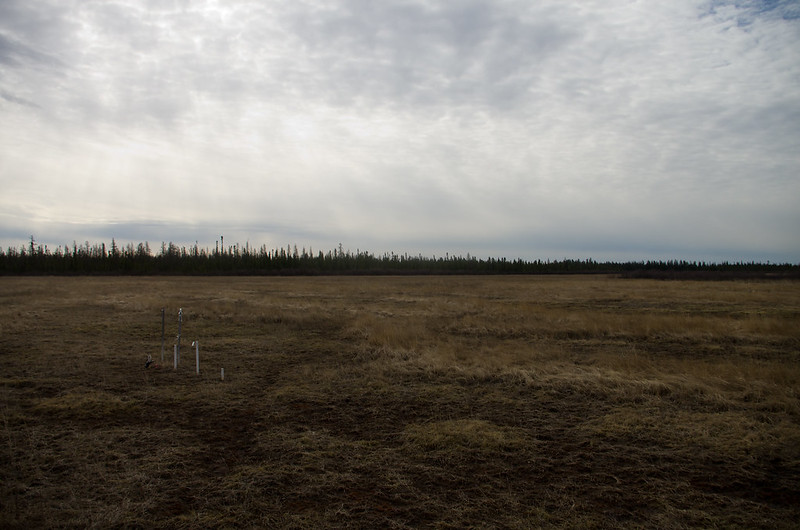
Saline April 2016 1
The Saline Fen. The pipes sticking up in the front-left are a nest of piezometers, used to measure water flows through this fen.

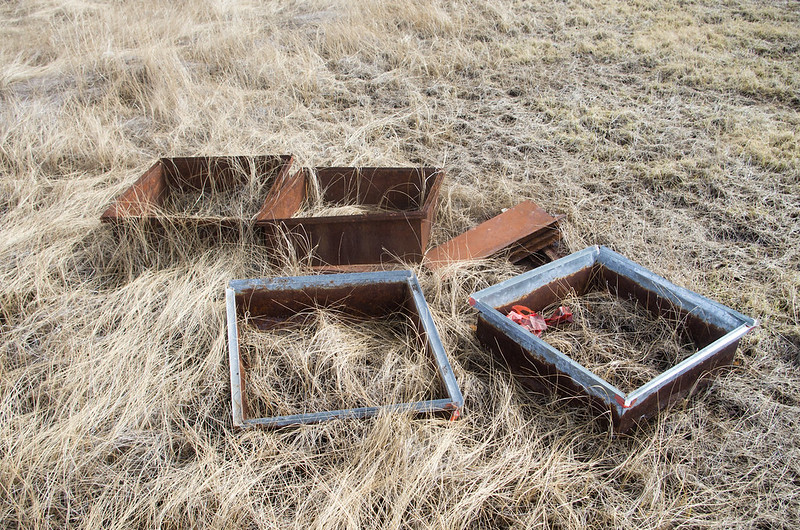
Saline April 2016 6
We use 60x60cm collars to isolate patches of ground and measure greenhouse gas exchange. Ours are constructed of steel, and rust rapidly in the salty peat of the Saline Fen.

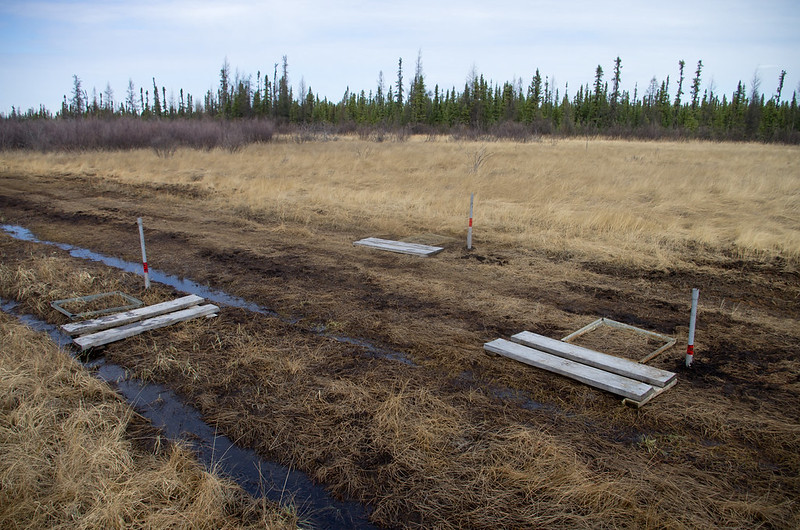
Saline April 2016 8
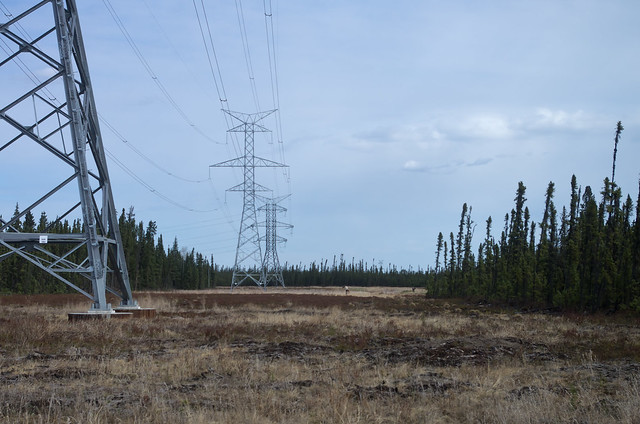
My new collars (actually, just relocated old collars that were not too rusty), on the cutline that cuts right through the Saline Fen. I'm not sure why this cutline was constructed; possibilities include to provide a winter road or temporary access to areas beyond the fen, a seismic survey looking for buried deposits (in this part of the world, oil), or some other reason.

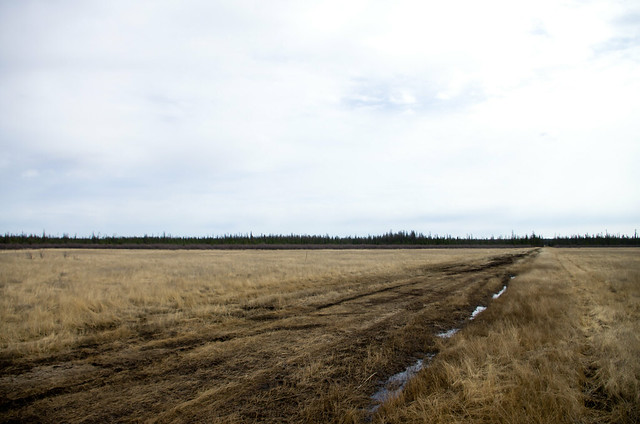
Saline April 2016 10
The cutline, continuing on to parts unknown.

Saline April 2016 11
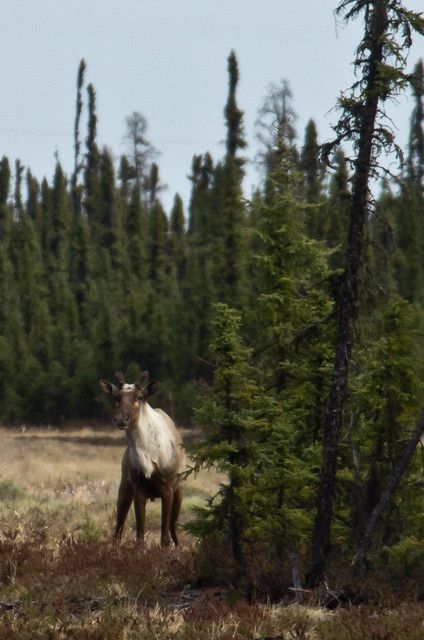
On our way out - surprisingly early, we were back at the truck by 11:30 - we spotted a couple of caribou (Rangifer tarandus).

Saline April 2016 13
One seemed a little curious about us.

We returned to the house in Fort McMurray rented by the University of Waterloo, and had a few small tasks to complete mostly concerned with getting ready for Sunday, with a visit to Poplar, a tree-covered bog.

Poplar Cutlines 3
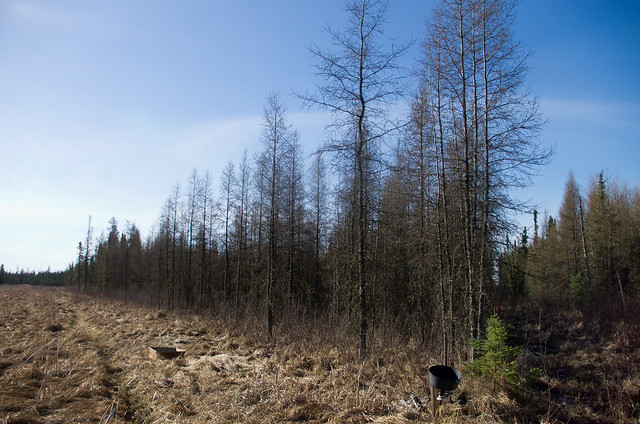
Poplar Bog. Both the "Large" and "Small" cutlines are visible here, along with the patch of "undisturbed" bog between them where I placed my reference collars.

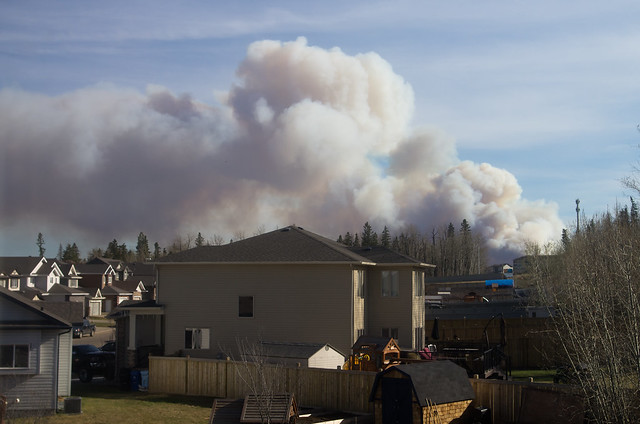
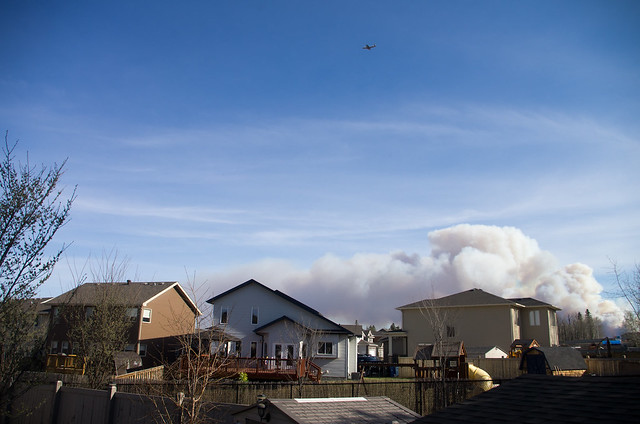
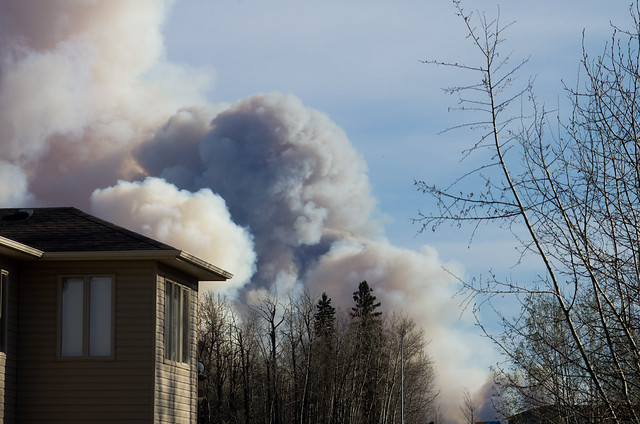
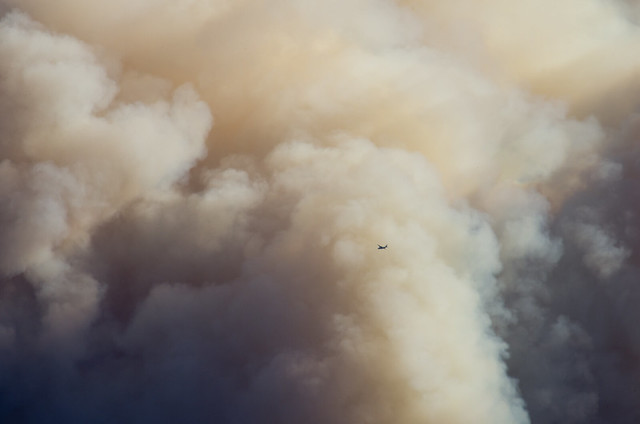
Despite a greater number of collars to install and more difficult soil conditions - ice was close to the surface at Poplar, and abundant tree roots made cutting into the peat especially challenging - we were again finished before lunchtime. My plan was to drive to Peace River, a road distance of nearly 700 km, on Monday so I could attend a required safety training course in Peace River on Tuesday morning. Sunday afternoon was thus spent in quiet relaxation. Later in the afternoon we noticed the smoke plumes to the south and to the north, indicating wildfires. Wildfires are not particularly rare in the boreal forest, and given the hot, dry conditions the area had experienced all April, such a fire in the forests near Fort McMurray was not surprising. 

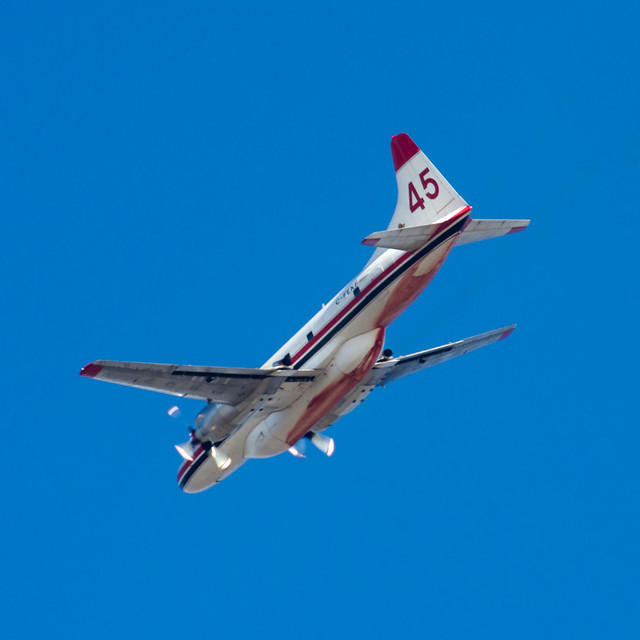
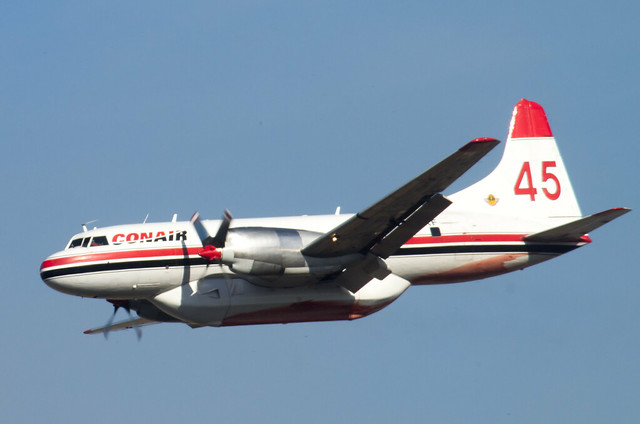
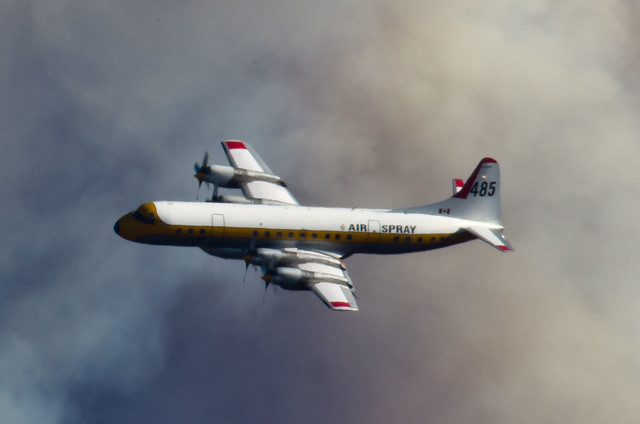
We treated the circling firefighting aircraft - we saw at least three water-bombers plus at least two helicopters carrying buckets and one "birddog" control-and-direction airplane - as a pleasant and interesting diversion on a sunny Sunday afternoon. I was a pretty enthusiastic airplane nerd when I was around 10 years old, and I snapped a few pictures.

Sunday Afternoon in Fort McMurray 1
Sunday Afternoon in Fort McMurray 2
Sunday Afternoon in Fort McMurray 7
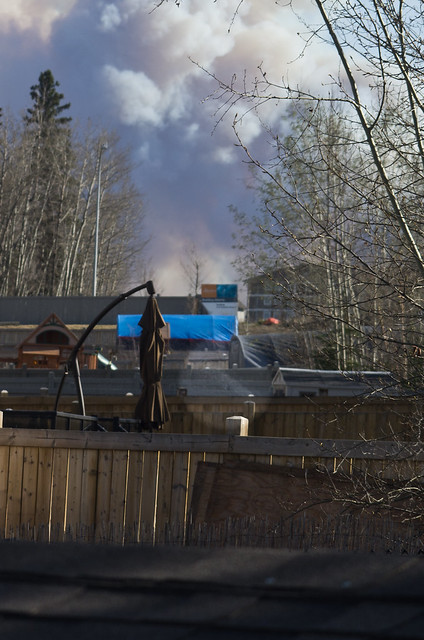
Suburbia-and-smoke shots

Sunday Afternoon in Fort McMurray 3
It's hard to see, so I've highlighted the water stream, but a neighbour a few houses down was watering their lawn. I took this picture thinking it made an amusing contrast, but in hindsight it takes on more of a futile-gesture feeling.

Sunday Afternoon in Fort McMurray 11
I snapped this shot off at an awkward angle, but it shows the red stain from the firefighting foam this airplane has been dispensing. I saw none of the famous Canadair scooper-type waterbombers, and these 'planes need to return to an airport after dropping their loads. The advantage of the foam over water is greater wetability - water isn't actually that wet, especially when splashed onto burning trees. And, I'm not certain that a scooper would be able to operate effectively around Fort McMurray - the Athabasca river has very few straight parts, I don't know how deep it is, and there are few large lakes in the area.

Sunday Afternoon in Fort McMurray 15
Sunday Afternoon in Fort McMurray 19
Sunday Afternoon in Fort McMurray 27

Sunday night was quiet - I don't think waterbombers usually operate at night - and Monday morning included a heavy haze of smoke over the city. I dawdled my morning, sticking around long enough to wash and dry the sheets from my bed, and triple-check I wasn't leaving anything behind.

Conditions cleared up completely once I was about 15km south of town, and my drive down the infamous Highway 63 was about as calm and uneventful as is possible. Highway 63 is infamous because of the high death rate during the peak boom years, about 4-5 years ago. The news across Canada would periodically cover the more spectacular crashes, most of which were generated by young men with large incomes and powerful cars beyond their abilities to properly control driving at ridiculously high speeds and making dangerous passes on the two-lane undivided highway. Last summer I saw intense construction activity all along Highway 63 from its junction with 55, about 250 km south of Fort McMurray; this year, they appear to have completely twinned the highway except for one short section that feels like a normal construction zone. I stopped for fuel in Wandering River, and continued on my way.

The rest of that drive is more interesting, but I'll save that for another post. It wasn't until Tuesday evening that I realized the wildfires I had seen near Fort McMurray were actually forming an existential threat to the entire city. Sunday afternoon we'd joked about the smoke, asking each other how far away that fire might be, and I remember saying something like "It must be pretty far away, they'd pull out all the stops if it gets too close to the city. There's no way they'd let Fort McMurray burn." The amazing damage to the city and the total evacuation puts the lie to my confidence in the unlimited abilities of northern Alberta firefighters. This fire - apparently now named "The Beast" - is beyond any normal human efforts, and I can only salute the crews working to minimize the damage from my safe vantage point.

Peace River is living up to its name, in stark contrast to the catastrophe I accidentally avoided.

Saturday, April 23, 2016

Book Club: Near Death in the Desert

Near Death in the Desert
True Stories of Disaster and Survival
Edited by Cecil Kuhne
Random House, 2009

I picked up this book in a used bookstore not long ago, realizing the useful niche between fiction and long-form non-fiction a set of short non-fiction stories like this occupies in my reading-for-entertainment habits. Cecil Kuhne has also edited a series of apparently similar volumes, listed in the front matter of this book with titles like "Near Death in the Arctic".

I assume Cecil Kuhne, in addition to choosing stories to include and separating out parts he wished to include from longer works (i.e., the work of assembling this volume) wrote the 1-paragraph texts that introduce and post-script each story. He does a very poor job at this, over-sensationalizing all of the stories (as much as the title does - few disasters are involved anywhere) and, more seriously in my opinion, opening one story with a bit of frankly racist nonsense. The oldest story fragment here is from the account by J.W. Powell of the 1869 expedition to explore the Colorado river and a part of the Grand Canyon. Kuhne states "Major Powell set out from Green River, Whyoming, to explore territory and rapids never before viewed by human eyes." (emphasis added by me) The story, which I can only assume Kuhne read, includes multiple mentions of the discovery by Major Powell of the remains of native American habitations, and plenty of description of such artifacts found overlooking the river as abundant broken pottery and the outlines of house foundations.

Overall, this wasn't a great read. The variety of voices was a strength, certainly, but despite covering adventures separated by more than a century (the most recent story takes place in the early 1980's) I found more in common among these authors than their voyages across hot sand and rock: none of them were particularly likeable or relatable. I think it's probably a hazard of this kind of extreme travel-writing that the author-adventurers start out as people of a tiny minority, who feel such a strong wanderlust that they set out on near-suicidal and deeply uncomfortable voyages (the squidgiest part of this book for me was the description of attempts to remove lice from clothing). They don't relate well to most "normal" people in their home societies, so they don't come across as particularly relatable in their day-to-day concerns or their long-term goals to most "normal" people, either. I don't consider myself particularly "normal" in this sense, and I like to imagine that I am actually closer to these authors along some hypothetical "stay-at-home / see the world" spectrum, but I don't like them. Perhaps I'm subconsciously worried that I will fall into some of their more unpleasant habits as I pursue my own adventures (lice aside, there is a general acceptance among these authors of some pretty blatant human-rights violations happening around them. Sure, what can a foreigner do, especially alone in a strange culture? But, that to me does not extend to slavery).

I'm leaving this book in the informal library at the hostel I'm staying at in Munich this weekend, perhaps one of my fellow travellers here will enjoy it more than I did.

Saturday, March 26, 2016

Betty Crocker Cookbook #39 Cuban Pork Sandwiches (pg. 451) - 160218

Rather than buy roast pork, or make it in the extremely limited time we had available, Charlie suggested we use the pulled barbeque pork out of the previous night's slow cooker.

No pictures, again, but I can blame the pickles for that - a fine addition to nearly any sandwich!

Betty Crocker Cookbook #38 Pulled Jerk Pork Sandwiches (pg. 157) - 160217

When I visit Charlie, I tend to buy a nice big piece of meat for her freezer and her slow cooker. This time, it was a pork shoulder. This recipe calls for a 2.5 pound boneless shoulder, but those are hard to find in Regina so we ended up with a 4 pound bone-in shoulder. This worked quite well, and the resulting sandwiches were fantastic. No photos, because apparently I get easily distracted by great food.

This also supplied "roast pork" to the Cuban Pork Sandwiches we made for lunch the next day.

Betty Crocker Cookbook #35: California Black Bean Burgers (pg. 504) - 160215

For my first foray into the Vegetarian chapter of the Betty Crocker Cookbook, Charlie helped me make burger patties out of black beans. The "California" part of the name comes from the salsa used as garnish during final assembly; I gather that such non-standard burger toppings are stereotypically associated with the hedonism of The Golden State.

I took no photos of these burgers, mainly due to the extreme mess that results from trying to force a fairly wet bean paste into a coherent patty. They were also excellent, so I didn't put down my burger to pick up my camera.

Betty Crocker Cookbook #36: Chicken and Broth (pg. 434) and #37 Quick Jambalaya (pg. 433) - 160216

I visited Charlie in Regina over reading break in February, and together we completed enough recipes in this project to add considerably to her store of frozen meals.

Several of the recipes we chose - chosen as we drove back to Regina from Cypress Hills - were set up as prerequisites supplying key ingredients to subsequent recipes. In this case, the Chicken and Broth supplied chicken broth to the Quick Jambalaya; we also added some of the cooked chicken that resulted, despite not being called for in the Jambalaya recipe.

Broth
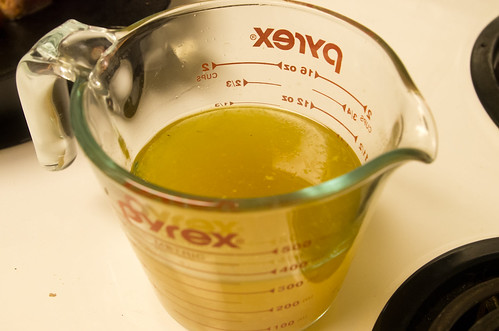
Some of the broth from the Chicken and Broth. I felt like we were using this simple recipe in the way the authors of the cookbook intended - this recipe doesn't produce a meal, or a component of a multi-dish meal, it provides ingredients to further recipes.

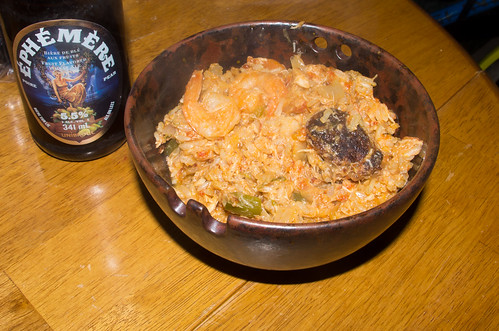
Quick Jambalaya
We didn't have frozen brown-and-serve sausage links as called for, and our shrimp still had tails, but we substituted regular sausages and added most of the smaller chicken pieces. I couldn't convince Charlie to dive all-in to this project and get instant rice, so we just simmered the jambalaya for longer and used regular brown rice.

Absolutely delicious!

***
 I had to go back and change the recipe numbers when I realized we made the California Black Bean Burgers Monday, and these recipes Tuesday.

Wednesday, January 06, 2016

Betty Crocker Cookbook #6: Chai (pg. 61) - 160105


We had intended to make Chai yesterday, to provide us with some caffeine to stimulate our cleaning-and-organizing activities on Charlie’s last full day here at Skootamatta. We forgot to even consider beverages – hot or cold – until most of the day’s tasks had been completed, including the overwhelming majority of the physical activity. We got most of the tasks that directly benefit from daylight – chopping and bringing in firewood, fetching lake water (Charlie had to chop ice with an axe), and setting up the heating system for Tarrandus, my truck (her cabin-heating system is broken due to a jammed-in-the-cold-position blend door, so I used a small space heater that runs off household 125v alternating current to pre-heat her before today’s 2.5 hour drive to Ottawa International). Thus we felt we wouldn’t need a caffeine fix at 5:00pm and opted for an alcoholic choice, instead (wine!).

Also, we’re pretty frickin’ Canadian around here.

No photo again, because, again, I forgot to take any while Chai was being prepared. The recipe is basically “add milk to brewed tea” plus some spices – though we didn’t have any cardamom so that was omitted. The hot, sugary (sweetened condensed milk accounts for about 1/9 of the total dairy in this recipe) tea went into a big thermos we had with us and we drank it as we drove down Ontario Highway 417 eastwards into Ottawa. It was, once again, really, really good.

***

Charlie provided me with an Excel file that includes all 634 recipes in the 2006 edition of the Betty Crocker Cookbook. So this cup of tea represents six down, 628 to go. Clearly, I need to increase my average rate to around two recipes / day if I’m going to complete this project in one year. Charlie convinced me this time limit should be my goal, because if I allow the project to drag out longer from the outset, I greatly increase the risk of never actually finishing it. A deadline is a useful thing for focusing my mind, and I’m already pondering options for completing some of the more ambitious recipes that require techniques I’ve never tried before such as deep-frying and candy-making as well as what to do with the tremendous amounts of food that some recipes will generate – there are three recipes that are built around whole turkeys (one involves a turkey-swallowing, propane-powered deep fryer), for example, plus half a chapter of casseroles. Not to mention the cakes, pies, batches of cookies, and general make-supper-for-your-whole-family recipes that form the backbone of this book.

I will be buying some non-food items to support this project, obviously. First on the list is a chest freezer, an item I’ve wanted ever since I gave my old one to a friend-of-a-friend when I left Saskatchewan. Other things I’ll be searching for include a candy thermometer, more plastic storage containers (to put in the freezer), and a waffle iron – I’ll be browsing the local thrift shops for this and a few other items, with Walmart and its ilk as my backup plan. I’m pretty sure I’m not allowed to have a BBQ at my apartment, so either I’ll be using a friend’s (helping with the what-to-do-with-all-this-food problem) or buying one for a friend, and visiting often.