Showing posts with label Sunday Drives. Show all posts

Sunday, March 03, 2019

Birthday Retrospective 41

Today is my 41st birthday, and I've been thinking about the last couple of years and how much has happened in my life. A year ago, I was in Québec (the city in the province), and a year before that I was in Waterloo, Ontario. Today, I am in Armidale, NSW, Australia. It's been quite a couple of years!

Being a post-doc is weird; this is something I say fairly often, probably a couple of times per week. I have been a PDF (post-doctoral fellow*) for about four years, and in that time I have done what seems like a pretty broad range of things at work. Besides the frequent moves - this is my fourth post-doc position, and more on that in a moment - I have taken turns working at particular skills that are typically important skills for university professors - and that is my career goal.

* Technically, I am a Fellow now, but my previous positions since my PhD have been "post-doctoral researcher"; the main difference is funding, in that a Fellow is supported by an award or funding from outside of the lab group or PI (primary investigator; a professor). Here at the University of New England, I have a contract and independent funding and my job title is officially a Post-Doctoral Fellow.

My first PDF, at the University of Waterloo, lasted about 2.5 years. In the final half year or so I started seriously looking for my next position, and I was contemplating relaxing my standards for advertised jobs I would apply for from strictly tenure-track to include interesting PDFs. The main busy period for such applications is the fall in Canada, but before I really got into a serious search - with a hard deadline for my position at U Waterloo of October 31, 2017 - I was offered a PDF with a professor I had met several times and already had the beginnings of a working relationship with. My U Waterloo PI was Dr. Maria Strack, and Dr. Line Rochefort at Université Laval had been one of Maria's PhD supervisors, about a decade earlier and they continue to work together. 

I moved to Québec at the end of September 2017, and in the personal chaos I lost track of world events; my first day of work at Laval was the day after Catalan held a referendum to separate from Spain - an event closely watched by many in Québec. My contract at Laval was short-term because Line was at the end of her main Discovery grant and had not yet secured funding for the next five-year period. She was applying for two other major grants in addition to renewing her Discovery, and needed a person to divert attention from her so she could focus on grant-writing ahead of deadlines in October and November. My job was largely to work with Line's students and others as the English-speaker: I was the only native Anglophone in a lab dominated by Québecois but with plenty of other nationalities and languages as well. I learned that I quite enjoy helping ESL scientists with the intricacies of technical writing in English.

The grants Line was applying for included funding for a PDF, and the unwritten agreement was that should any or all of the grants be successful, that position would be mine if I wanted it. The dates we would learn about the success or lack thereof of these grants were in late March, and my 7-month contract at Laval was set to end at the end of April. In late January, as I was struggling to make plans beyond that end-April horizon, other professors I had worked with forwarded a job ad to me, at Laurentian University in Sudbury, Ontario. 

Dr. Nathan Basiliko paid for me to visit Laurentian in late February - about a week after I first spoke with him and other professors at Laurentian - for a large meeting to bring together nearly everybody involved in a large collaborative grant they had been awarded. That was an interesting meeting, and at the end of the two days I agreed to move to Sudbury to work with Nathan. A big part of my decision was the 2-year contract on offer, as well as the opportunity to expand my expertise into different areas of Restoration Ecology.

Sudbury is a fantastic place, and I thoroughly enjoyed living and working there. After only a few months in Sudbury, I was made aware of an opportunity in Australia, to work with people I'd met when I visited Charlie in December, 2017. Dr. Romina Rader and Dr. Susan Wilson were willing to Nominate me for a UNE PDF, with the first application deadline in early July. There's a long story there, but the upshot is we were successful at the first stage, and I was invited to complete a full application with a 5-page proposal to replace the 1-page version in the first application, due in early September. We were successful again at this second stage, and a Skype interview was scheduled for mid-October; I was told I could expect to hear the decision in about a week.

Around 10 days after the interview, I was informed that UNE was offering me the position. This converted November and December into frantic preparations to move around the world. Charlie had joined me in Sudbury and we had to coordinate this massive undertaking while both of us continued to work - me at Laurentian, trying to wrap up what I could before leaving, and her with the lab work and data analysis stemming from her "summer" job in Sudbury. 

Somehow, we accomplished everything, and moved out of our Sudbury home and drove to Calgary just before Christmas, 2018. That is another story of its own. We were granted our Australian visas and booked our flights somewhere between Winnipeg and Regina, and flew without further drama on January 8th, and over the International Date Line on January 9th, consigning that day to the Time Vortex and landing on the 10th.

Australia has been excellent and wonderful so far, and promises to continue to be so. I baked myself a Birthday Cake today and both Charlie and I have been relaxing and taking it pretty easy all day. On Charlie's suggestion, my Sunday Drives - restarted after a long hiatus in Ontario and Alberta - have become "Sunderday" Drives, a term coined by a good friend of Charlie's in Sudbury. The Sunday Drives were never tightly linked to any particular day of the week, but the move to Saturdays (three such drives have been completed so far) flips the feelings of the two weekend days. Previously, Saturdays often became unpleasant errands-and-chores days, with long hours spent shopping for non-exciting, necessary things and little time to maintain our home with such tasks as laundry or general tidying-up. Now, Saturday mornings are given to shopping for furniture and other necessary things (shops, especially thrift stores, are open limited hours on Saturdays, often closing shortly after noon, and are largely closed entirely on Sundays), with our departure for more fun driving and sight-seeing happening after lunch. This makes Sunday a wide-open day where we can each decide to accomplish as much or as little as we like. Today, for example, I hung an Art on the wall, and baked the afore-mentioned cake. I'll make supper and maybe wash some dishes, otherwise the day is filled with far less useful tasks.

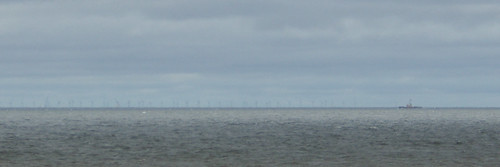
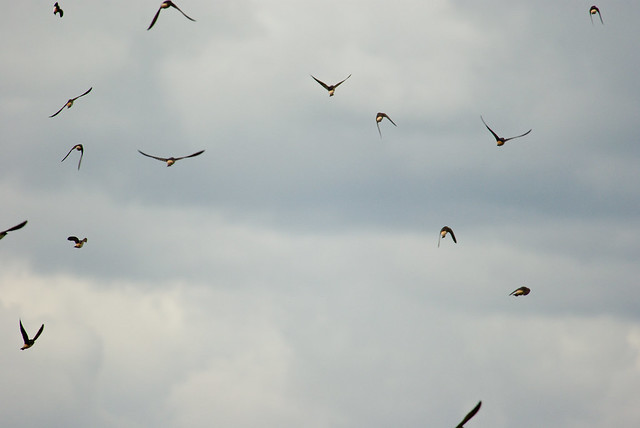
I've been trying to get into a habit of photo-editing, with some success, so here is a recent photo.
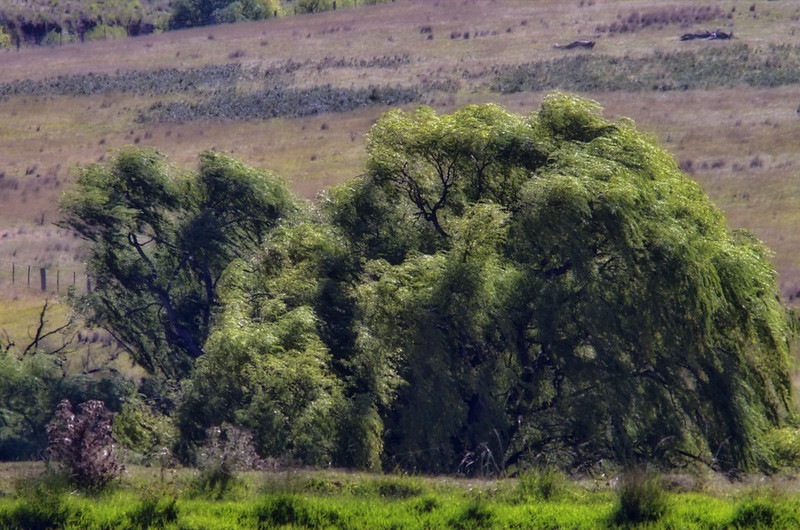
SD 197 Supertele Landscapes 01

Wednesday, December 12, 2018

Moving to Australia

I am deep into moving mode, an emotional state that places a voice inside my head that repeats a few phrases whenever I ponder a wide range of physical objects: "No! Do not buy that!"; "Will this be taken with, packed for storage, sold, or donated?"; "The miniproject you had in mind for this is gone, a dead dream. Let it go.".

This is annoying, I much prefer my normal happy-go-lucky approach to possessions, though this current mood has considerable benefits when it comes to that other major category of possession, money. I would not say I have ever been very good at money, in the sense of avoiding or paying off debts effectively, saving money, and preventing myself from making probably-ill-advised purchases. Between the increased attention I've been paying to my personal finances since late summer and the material needs (i.e., for less material) of my impending trans-Pacific move, my money situation has both clarified and improved. This move to Australia comes with another substantial benefit on this point: a large raise.

As a post-doc in Canada, from my position at the University of Waterloo, through my short half-year at Université Laval, to my current-and-soon-to-end half-year here at Laurentian University in Sudbury, my salary has stayed pretty constant, at about $45 000 / year. My recent improvement in financial self-oversight does not extend far into the past, but I am confident that I can maintain something like my current lifestyle on this level of income. The new position in Australia comes with a salary nearly double that, and while the cost of living will probably be a bit higher, and the move itself represents a significant expense, I anticipate being able to live a slightly more comfortable life there. My current debts would be paid off by mid-to-late 2019 were I to stay here in my current existence, so I anticipate greater chances of success in this goal, even with the currency-conversion and interbank transfer fees I'll incur paying off Canadian debts from Australian income.

So that's one reason why I'm moving. The other, more important reason, is love. Charlie will be starting her PhD in 2019 at the University of New England (as long as certain things go reasonably well, which they mostly have already been doing), and this position for me is in the same laboratory group, so we can STAY TOGETHER! YAY! I have been awarded a University of New England Post-Doctoral Fellowship (UNE PDF), a competitive award that comes with a 3-year contract and considerable support in the form of specific training for professor responsibilities such as effective teaching and applying for outside funding; I am very much looking forward to learning about and practicing both of those.

I think I'll save the application process story for another post, after I arrive in Armidale and take up my new position, just to avoid any public-information weirdnesses - I'll have a chance to clear some things I might want to talk about with the relevant people there.

The third reason I'm moving to Australia is of course ADVENTURE. Ironically, Sudbury is an AMAZING place for EXACTLY the kinds of adventures I am most interested in having. This isn't the canoe capital of Canada - Atikokan, Ontario, a thousand kilometres away, claims that title - but it's a very close second. Greater Sudbury, the coalesced super-municipality of Sudbury plus a large number of suburbs, includes 331 lakes within the borders. My office here looks directly out (I mean, directly - the distance from window to water is about 3 metres) onto Lake Ramsey. Within an hour or two of driving, there are at least half a dozen Provincial Parks with mapped canoe routes, water-access-only campsites, and maintained portages; this includes the jaw-droppingly gorgeous Killarney Provincial Park, which we have managed to visit only once. We'll be back.

I have been spending some of my procrastination time browsing the websites of the State Parks of New South Wales and of Queensland, plus a number of other similar get-out-and-explore Australia websites. The Sunday Drives, which have been dormant here in Sudbury since October (not that I post about them but I do go on them!) will be restarted as soon as possible in Australia. Like Sudbury, Armidale is surrounded by some amazing protected areas that I can't wait to explore.

The move itself has been (and continues to be) a large and seemingly never-ending amount of work. We received the Letter of Offer in late October, so we had about two months to do all things needed for a move like this. Packing, and sorting possessions into take/store/sell/donate has taken much of our time, but some things further from our direct control also require both long times and considerable effort. The visa application, again without talking about it in detail given we have not received it yet, is the obvious example, with published estimates on government websites that our visa may take two months to be processed, though hopefully much less. UNE has hired immigration lawyers to help us, and Visa Lawyers Australia (VLA) have been absolutely wonderful. There's a lot to say in the future about this process, too, but I can say that VLA has been great.

Selling things has been surprisingly effective, I had not expected to make nearly as much money as we have - with more (hopefully) to come - through Facebook Marketplace and eBay. Large things that are not worth shipping, mostly furniture, have gone to local people, organised by Charlie. Smaller things with narrow appeal - mainly my old camera gear - has gone out through eBay. I have bought a bunch of things (including old camera gear) through eBay, but until this move, I had never sold anything. The first to go was my collection of Dragon Magazines, to a few buyers in Ontario and Quebec. Camera stuff has gone to B.C., Alberta, Saskatchewan, Manitoba, Ontario, and Quebec, as well as several American states. In some cases, the cost of shipping exceeds the cost of the item by up to double, but the buyers are willing and the post office is nearby.

That said, if you feel like browsing what I've got up, there are a few more auctions left to run before we drive west (next week), search for "martinb003" on ebay.ca and you'll find me.

Our plan for the move, now well under way, is to drive to Calgary for Christmas, then fly to Armidale by Calgary - Vancouver - Sydney - Armidale. Qantas flies at least once a week on the critical Vancouver - Sydney route, and a few other airlines such as Air Canada also make that trip on most days. We want to avoid stopping in the USA because while it potentially could be less expensive (though not necessarily, as we have seen browsing ticket sellers) there is a large and worrying possibility of all kinds of hassle with US Customs that we would prefer to just dodge. This emotional state comes with strong prioritisation to minimize time and worry requirements in favour of getting stuff done, because there are so very many things to do.
Friday, June 10, 2016

My Leatherman

7 Years

I had my Leatherman tool, on my belt, for seven years. My soon-to-be-PhD-advisor-at-the-time, Dr. Steven Siciliano, gave me a Leatherman Charge TTi - a top-of-the-line multitool - before my first field season with him and his research group in 2009. He gave it to me around March or April of that year, and I've worn it on my belt nearly every day since then.
That's around 2500 days of that lump of complex, hinged, bladed metal on my left hip. I've gone through three sheaths and I don't know how many subconscious hand-passes over my belt to make sure its still there.

Early this year I accidentally tried to take it through security at Pearson International Airport, on my way to visit Charlie in February. The security personnel were quite nice and polite about it, and let me mail it back to myself in Waterloo; it was waiting in my mailbox when I returned a week later. 

At the end of my 6-week-long bookended-by-conferences early-summer-2016 fieldwork I sent it in to Leatherman's facilities in Burlington, Ontario, for warranty repairs. Before I flew from Calgary to Fredericton, I went to Canada Post and sent it to Ontario. Tonight, it has been returned to me.

Or rather, an updated substitute has been returned to me, and my Leatherman is no more. Because the Charge TTi has been replaced in the Leatherman Inc. lineup by the Charge Titanium, that is what I now have. This new Charge Titanium is a thing of beauty, a tool of vast utility that fits perfectly with the accessories (sheath, screwdriver bits) I was instructed not to send in. But it's not my Leatherman (yet).

The knife blade is flawless, not the chipped, scratched, and haphazardously-sharpened blade I used to cut ludicrously-fresh tomatoes and pears on the top of an Arctic mountain.

The saw blade is perfect, not the scratched, difficult-to-open tooth I used to cut branches and an uncountable number of zipties (using the sharp hook on its tip) on seven years of Arctic expeditions and Prairie Rivers canoe trips.

The file - both sides! - is clean to the point of optical illusion along its cross-hatched surface, and bears no trace of the steel soil-gas probes I filed and filed and polished and cursed before fitting their machinist-perfect but field-work-distorted hammer-cap on to drive into the rocky soil of the Arctic polar deserts.

The pliers are smooth and shiny, not the sticking, misaligned grip I pulled endless nails from endless boards with.

Even the scissors, tiny and sharp, are quite excellent, and not the cutters I pushed and squeezed through paper, string, cardboard, and plastic over the majority of a decade.

I'm going to enjoy and appreciate this tool over the next seven years - or more! - but I do feel like an old friend has been lost, and a concrete symbol of my PhD has disappeared.

Thank you, Leatherman, for making such fine tools. I hope my use of this new multitool lives up to the legacy of the previous one. And thank you, Dr. Siciliano, for sending me down this pathway seven years ago.

Sunday, September 25, 2011

Sunday Drive 64: Afsluitdijk and IJsselmeer

Saturday, July 9, 2011

Before I travelled to the Netherlands, I talked to several people (in real life and on-line) about renting a car in the country and driving around. While everybody acknowledged the excellent train system and bicycling possibilities, I was also told that as long as I stay out of Amsterdam, driving in the Netherlands is a fine way to get around and really explore some places not easily reachable by other means (plus, I'm lazy and out of shape so long bicycle rides were a bit less appealing).

There were two examples of Big Engineering I wanted to see: the Afsluitdijk, which divided the former Zuiderzee into (part of) the Waddenzee and IJsselmeer, and the Delta Works, a series of dams, dijks, canals, and other structures that protect the province of Zeeland and important places further inland such as Rotterdam from flooding during large storms in the North Sea. In Dutch, -zee usually seems to indicate seawater (i.e., salty) and -meer a lake (i.e. freshwater). The IJsselmeer is a huge, shallow lake and since its creation nearly 80 years ago has had some areas walled off and pumped dry to create new land. Zeeland is a large and relatively sparsely populated province that would be almost unhabitable were it not for the protections built after a devastating flood in 1953.

I went with Andy to Schiphol airpot early Saturday morning - it's easier to check out of a hostel and ride the trams and trains with another person, even if both of you are carrying luggage. Andy headed for the departure lounges, but I turned left and entered the rental-car zone. Six car-rental companies operate counters at Schiphol, and because the Hertz desk had a small queue (and because their website had strongly implied much higher prices for walk-ins compared to on-line reservations, which I didn't want to do through the wi-fi at the hostel) I went to Europcar. I expect all of the companies had very similar prices and cars and at this point I'm not interested in being proven wrong - besides, no price quoted on a website ever carries over to real life in my experience. There's always *something*...

Anyways, arranging the rental was pretty straightforward. They gave me a choice of three cars in the second-smallest size class (smaller cars are much less comfortable, and cost trivially less to rent); I went with an Opel Corsa because we don't have Opel in North America. Of course, Opel is just a brand within General Motors, but there are different cars from even the large multinationals in Europe compared to North America (though the differences are less than I expected). As I expected from a rental, an Opel Corsa is more "driving appliance" than "proper car". It was boring, but massively reliable and thoroughly practical. They offered me a satellite-navigation system to rent for something like 12 Euros / day, but I'd brought along my Garmin GPS unit (named Serena) and downloaded their map of Europe before my trip. As an aside, despite the high cost of that map (about $100 through Garmin's website), it was very worth it. Not just for my driving around, but also getting lost in Amsterdam and other cities while walking.

It took me a little while to figure out the car, mainly the goofy windscreen-wiper controls and the very grabby clutch, but I was underway on Dutch motorways pretty quickly. Needing breakfast, I fumbled with Serena after I got off the motorway and found a small shopping plaza, I think in the town of Zwanenburg. At 9:00am, shops were just starting to open, and I helped a young man practice his English when I bought some ham-and-cheese pastries to enjoy just before the rain resumed. The pastries were very tasty, and the local crows watched me eat but politely waited until I was done before swooping in for the crumbs.

Once I got the car figured out and Serena fastened to the inside of the windshield, I poked around a bit and discovered I was pretty close to Zuid-Kennemerland National Park. The name "Parnassia", which is one of the park entrances, just sounded enchanting so I told Serena that's where I wanted to go, and I was off.

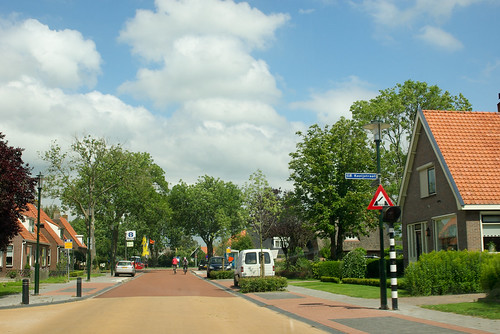
Sunday Drive 064 01 Zwanenburgdijk
Getting out of Zwanenburg involved a short drive along the Zwanenburgdijk. Narrow roads like this one, with zero shoulder and frequent traffic-calming devices, are abundant in the Netherlands.

Sunday Drive 064 02 Edge of Zuid-Kennermerland
Once past the traffic and roundabouts of suburban Haarlem, I quickly reached the edge of the Park.

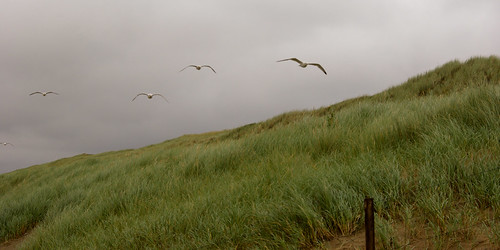
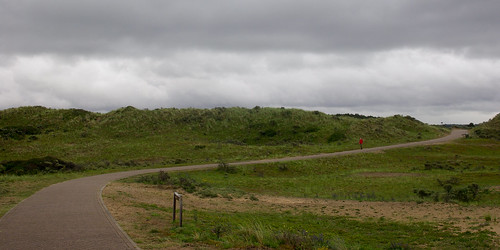
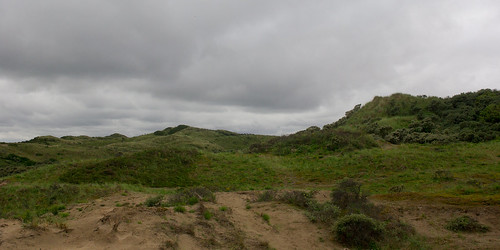
Zuid-Kennemerland National Park is built around the near-shore dune system, the ecology of grazing animals (semi-wild horses and cattle) on the scrubland vegetation in the dunes, and the broad beach at the North Sea. Parnassia is a small facility consisting of a restaurant with patio and a modest sandy walk down to the beach, with close access to trails leading through the dunes. The weather at the time of my visit was exactly what I was expecting when I saw on the map that I was close to the North Sea: rain, wind, grey. Perfect.

Sunday Drive 064 03 Parnassia

Sunday Drive 064 04 Parnassia seaward dunes

Sunday Drive 064 05 Parnassia Beach 1

Sunday Drive 064 06 Parnassia Beach 2

Sunday Drive 064 07 Parnassia Beach 3
The structures on the horizon in the middle of this picture are on the breakwater protecting the entrance to the Noordzeecanal.

Sunday Drive 064 08 Offshore Windfarm
This is a very tight crop of a picture I took looking straight out to sea from Parnassia. The offshore windmill farm I saw from the airplane is just visible here, along with what I think is a tender ship.

Sunday Drive 064 09 Larus
The gulls (Lesser Black-Backed Gulls, Larus fuscus, I think) seem to like weather like this even more than I do.

Sunday Drive 064 10 Parnassia Trail

Sunday Drive 064 11 Dunes and Vegetation at Parnassia

After my wanderings near Parnassia, I tried to pay for parking at the automatic booth. It did not accept coins, nor any card I happen to possess. In my fumbling to get the machine to return my ticket so I could pay at the exit gate, I accidentally called the attendant. He was able to sort me out, and take my coins when I got to the exit.

My goal was neither bracing North Sea weather nor tasty pastries, so I set Serena towards the town closest to the Afsluitdijk on the south side, Den Oever, and returned to the Dutch motorways. Normally on my Sunday Drives I just leave my GPS on wanderings mode, showing the map and my position & velocity but not giving directions to anywhere in particular. In the Netherlands, I mostly chose destinations and had Serena give me directions, which was very useful both for getting to interesting places like National Parks, and for freeing me from navigation decisions when passing through small towns with many bicycles, traffic lights, and pedestrians to watch out for.

I got off of the motorway as I approached the dijk (the A7 runs right over the Afsluitdijk) and found a quiet side road near the dijk that protects Den Oever and the adjacent village of Ooserland from storm surges coming through the Waddenzee.

Sunday Drive 064 12 N242
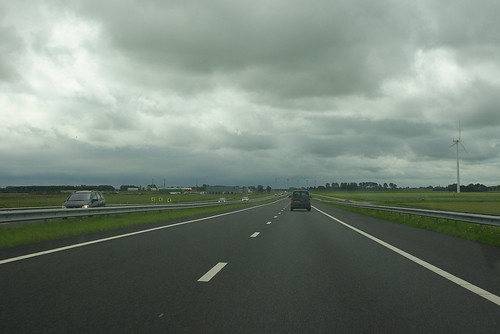
The N242 is a smaller road than the A7; I think the N-series are comparable to most 2-digit highways in Canada, while the A series are freeways; I refer to the A roads as motorways following the British convention for talking about big highways without stoplights (apparently I am alone in this habit).

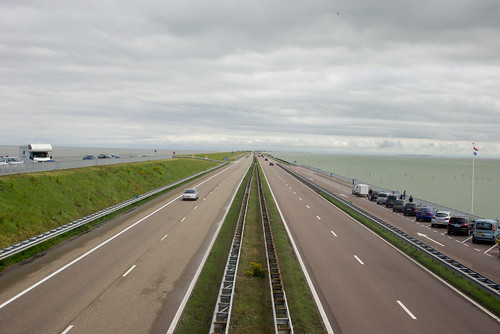
Sunday Drive 064 13 A7
I think this illustrates the difference: this is the A7, which is divided highway with a central grassy median.

Sunday Drive 064 14 Opel Corsa 1
Sunday Drive 064 15 Opel Corsa 2
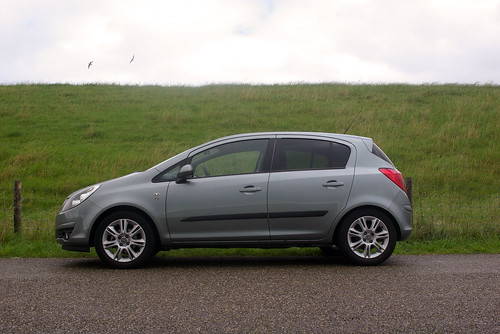
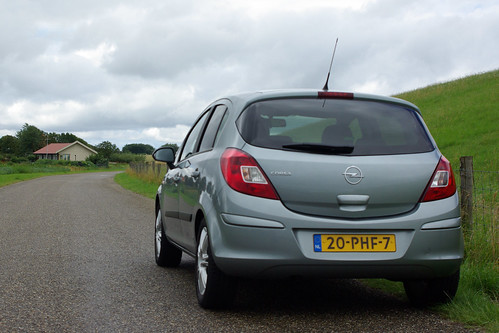
My car for a few days: an Opel Corsa, in dull-as-dishwater dark silver. Still, it handled reasonably well, was comfortable, and never failed me.

Sunday Drive 064 16 Waddenzee
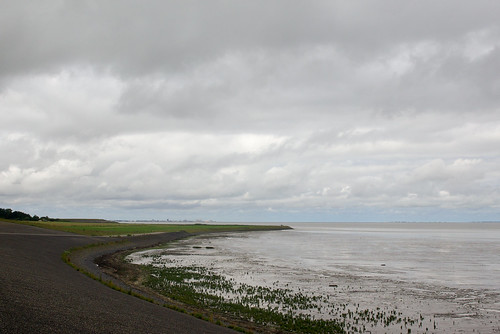
Looking west along the shore of the Waddenzee

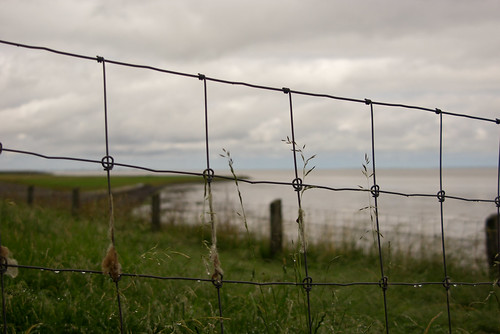
Sunday Drive 064 17 Waddenzee Fence
Playing with depth of field.

After my little diversion at the Waddenzee, it was time for the main event: the Afsluidijk. Really, it's not too visually interesting, as it's a straight dijk that runs for 32 kilometres and is as close to perfectly level as any human-made structure. Fortunately, there's a monument and some other facilities near the middle.

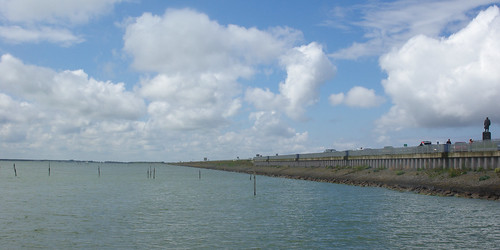
Sunday Drive 064 18 IJselmeer and statue
A view of the Afsluitdijk and statue of Cornelis Lely, the primary architect of the dijk.

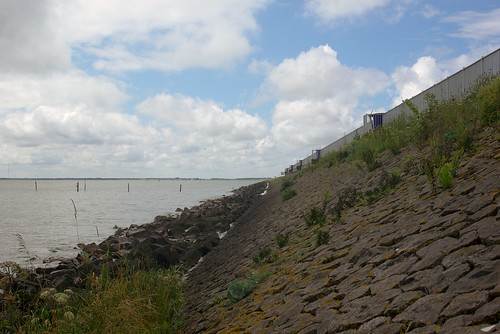
Sunday Drive 064 19 IJselmeer Stones
The freshwater-side of the Afsluitdijk, showing the top layer of stones applied to the dijk as it was constructed. Every one of those stones was fitted by hand, though they were transported to the site by machinery.

Sunday Drive 064 20 A7 to Friesland
Looking northeast from the overpass. It really is a rather boring bit of scenery, but its history makes up for it (in my opinion).

After going full-tourist on the Afsluitdijk, I continued across. I wanted to get off the A7 as quickly as possible, but I made a few wrong turns and missed exits before I could make my way back to the shore of the IJsselmeer.

Sunday Drive 064 21 Frisian Farm
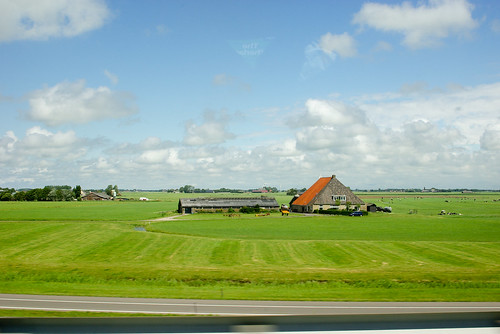
A farm in Friesland. Lots of Dutch farms look like this, from what I saw. The Netherlands has some of the world's most efficient and productive agriculture, according to some sources.

Sunday Drive 064 22 IJselmeer Dijk in Friesland
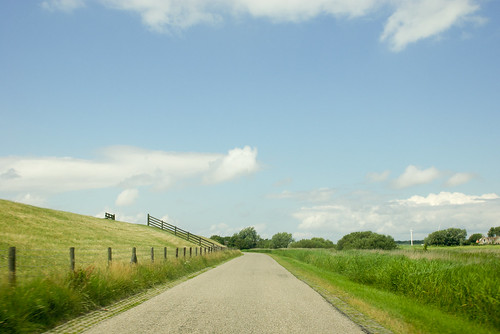
Wandering around, generally heading towards the water, I eventually found myself on the road that runs along the base of the dijk that separates Friesland from the IJsselmeer. Unlike most of the other dijks I drove along in the Netherlands, I could not find any place open to the public to climb over and see the water.

Sunday Drive 064 23 Frisian Church
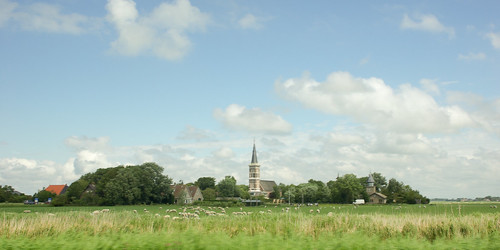
Many of the churches I saw were not located within a town or village, and instead were surrounded by agricultural lands.

Having satisfied myself with the Friesland shoreline area, I perused my maps and set my GPS for Weerribben-Wieden National Park. This took me out of Friesland and into the province of Overijssel, but for atmosphere's sake I played with the car's radio until I found a station that might be broadcasting in Frisian. This is the local language, which is supposedly quite distinct from Dutch; I have a tin ear or something because I couldn't really tell the difference.

Sunday Drive 064 24 Funky Bridge
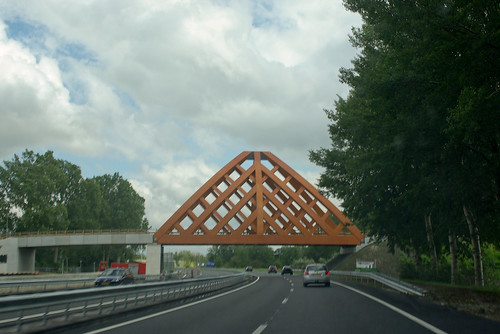
The Dutch are masters of bridge-building; every possible design appears in some form, somewhere in the country. I quite like this wooden structure, one of a pair, that crosses the A7 near Sneek.

Sunday Drive 064 25 Ossenzijl
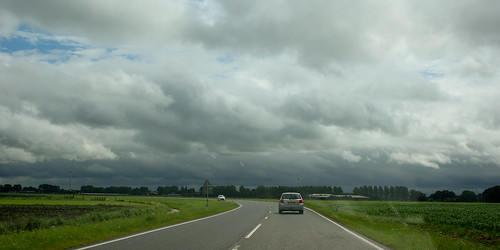
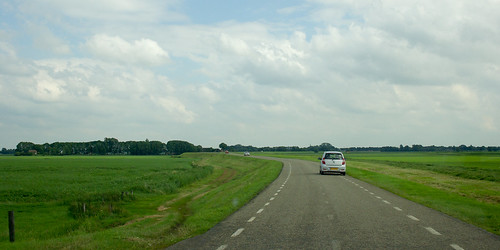
I accessed the park at its north end, through the town of Ossenzijl. Dutch roads always seem to provide just enough time to adjust and mentally switch modes from motorway driving (pay attention to the cars, drive faster than 100km/h) to town-and-country driving (pay attention to the bikes and pedestrians, keep it under 50).

I'll talk more about the park in a future post about the wonderful national parks of the Netherlands that I visited. I only spent about 20 or 30 minutes at Weerribben-Wieden, mostly because I wanted to press on with my big drive - it's a beautiful area, and I'd be happy to spend several days there.

Looking at my maps and my GPS, I decided I had spent too much time on really big roads that don't show much of the country, and I discovered a nearby road that runs along the top, rather than on one side, of a dijk with the badass name of "Hammerdijk". Of course I had to drive it. It turns out this road/dijk is approximately the border between the provinces of Overijssel and Flevoland.

Sunday Drive 064 26 Hammerdijk 1
Driving along the top of the Hammerdijk.

Sunday Drive 064 27 Flevoland Farm
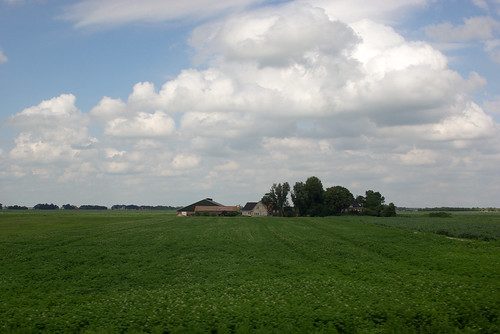
Another presumably-high-efficiency Dutch farm, just over the border in Flevoland.

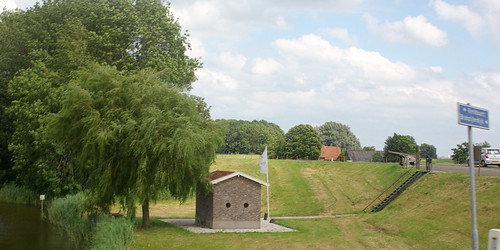
Sunday Drive 064 28 Hammerdijk Defences
I don't know what was going on here with this little stone hut and the freakin' cannon on the dijk, I suppose I should have stopped. Farmers displaying their stuff prominently near roads seems to be fairly universal though, so perhaps instead of a plow or an old combine, this farmer has a Napoleonic (?) bit of fortifications. The signpost indicates two roads that meet on the Hammerdijk, Kerkbuurt and Blokzijlerdijk. The name of the road on the top of the dijk apparently changes along its length, perhaps the beligerence indicated by the cannon had something to do with this?

Sunday Drive 064 29 Hammerdijk 2
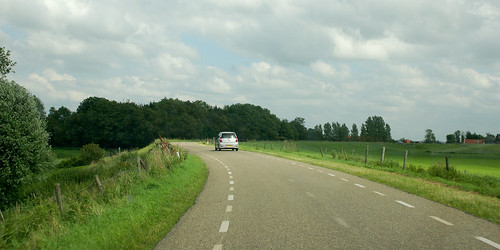
As I think I mentioned previously, many roads are narrow enough that even small cars must move into the bicycle lane when encountering oncoming traffic. Here on top of the presumably-centuries-old Hammerdijk, such narrowness at least makes sense.

Having satisfied myself with some dijk-driving, I set course for Almere. The province of Flevoland, which contains Almere, is largely composed of large polders constructed after the IJsselmeer was created. My Lonely Planet guide describes the province as:
"Flevoland, the Netherlands' 12th and youngest province, is a masterpiece of Dutch hydroengineering. In the early 1920s an ambitious scheme went ahead to reclaim more than 1400 sq km of land - an idea mooted as far back as the 17th century. The completion of the Afsluitdijk...paved the way for the creation of Flevoland."
Then the book goes on to describe Flevoland's cities as "grindingly dull places, laid out in unrelieved grid patterns." and doesn't mention Almere, a city of nearly 200 000 people, at all.

Sunday Drive 064 30 South shore of IJsselmeer
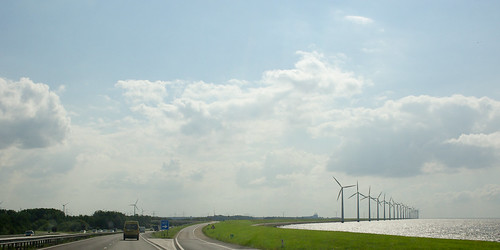
The shore of the IJsselmeer is lined in several places with large arrays of windmills.

I arrived in Almere, travelling mostly on high-speed, bordered motorways (borders of trees block out much of the road noise from surrounding areas, but conceal those areas from view from the motorway), at around dinnertime. Many businesses in the Netherlands close earlier than I'm used to, such that approximately nothing was open by the time I found a parking meter in downtown Almere. Some sort of festival or event was just packing up in one of the main squares, and the local McDonald's was full of children. Even here, so far from the usual tourist areas, the employees understood my English (smiling and waiting for the machine to show me numbers makes things easier).

I ate at McDonald's, rather than looking for something more "authentically Dutch", in reaction to my Lonely Planet guide. If I'm going to be in a cultural wasteland, I might as well dive fully into this dull grey nothingness. Having said that, I have no problem with McDonald's or their food; you get what you expect, at least. Plus, I was at the edge of a large mall in a concrete jungle built from recently-drained seabed within the past few decades. Throw some grime on everything and add a few flying cars and it would be a great stand-in for Blade Runner.

My Lonely Planet guide was more-or-less correct about most things, even if it sometimes takes a condescending tone, so I relied on it again and chose a bed-and-breakfast in Amersfoort as my first choice for the evening. I didn't want to drive in any big cities (parking is death), but I put together a vague plan in my head to try for Amersfoort first, then look for a motel or something in Utrecht if accomodations were very busy.

Serena was able to locate not only the B&B in its four-centuries-old building, but also the best way to enter the old town center of Amersfoort. The B&B itself was not very well marked, not with big signs or other clear indications that I was naively expecting for a place that charges money to sleep there. I found a big black door that seemed unlikely to be for a simple residence, and I knocked. I was let in, and at the desk made the happy discovery that they were far from full even on this lovely weekend, and their prices were quite reasonable - about 70 Euros for my own room with a shared bathroom (shared with nobody else - they were much less than 1/2 full) and a place to park my car down the street.

Having woken up very early after a noisy night of limited sleep, I was more tired than I expected when I got myself settled into my room, and I crashed on the very comfortable bed at some embarassingly early hour. The evening light was lovely, but I couldn't pull myself together enough to explore the town. Instead I resolved to spend as much time the next day here before moving on with my explorations.

Sunday, June 26, 2011

Sunday Drive 63: Bald Tires and Wet Gravel

Sunday, June 26, 2011

Start: 331429.0
End: 331700.5
Driven: 271.5
This week's album: Reanimation by Linkin Park


This morning I realized I'd woken up too late to participate in today's autocross with the SSCC, but my tires are in pretty rough shape in any case so I hadn't really planned on melting more of them onto the parking lot of the Credit Union Centre. Still, I felt like I needed a drive, bad tires or no. I remembered I'd last driven Saskatchewan Highway 784 from east to west back in mid-winter (Sunday Drive 46, January 16 of this year), when it was covered in snow and in some places thick enough that I had worried about getting stuck. I thought I'd check it out when the risks were from liquid, rather than solid water.

SD 063 01 Saskatoon Traffic
SD 063 02 Ominous Onramp
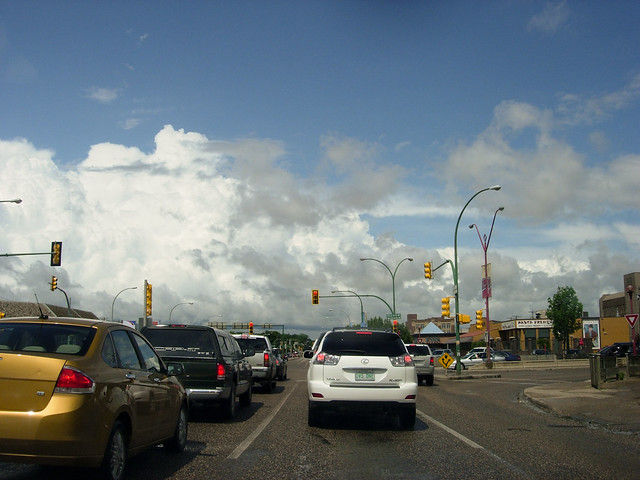
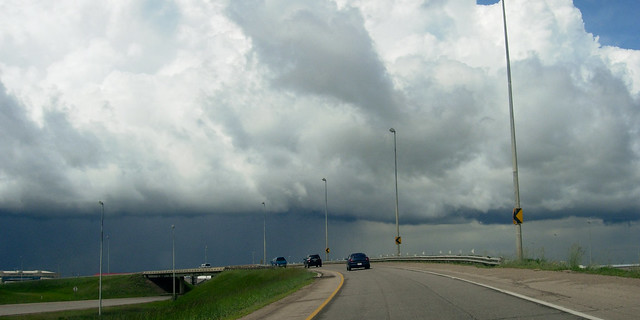
It had rained a few times over the last few days, and the sky was still full of various clouds. Driving north up Idylwylde Drive in Saskatoon I could see I was headed towards at least a few big dark clouds.

The last time I tried to get onto Highway 784 from Highway 16 I had nearly missed the turnoff. This time, I turned too early, and ended up driving south on a "range road", a four-digit gravel road that took me back towards Saskatoon's northwest neighbourhoods. When I realized this, I turned right (west) on the first decent-looking cross road, which turned out to be in very poor condition.

SD 063 03 Range Road
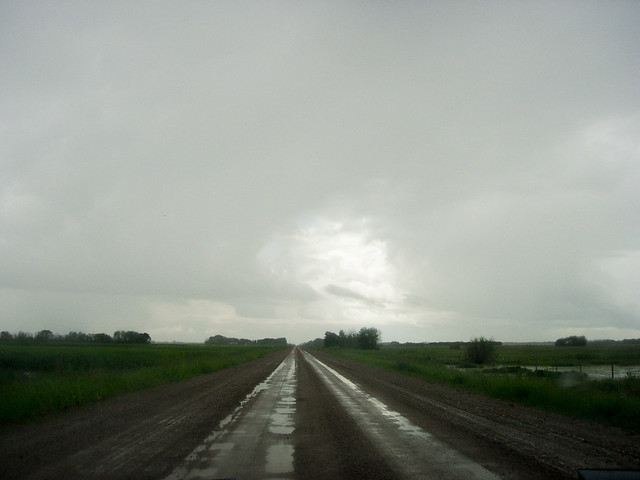
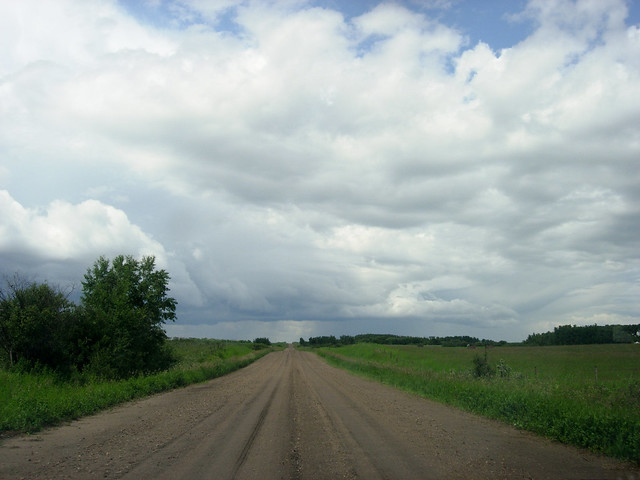
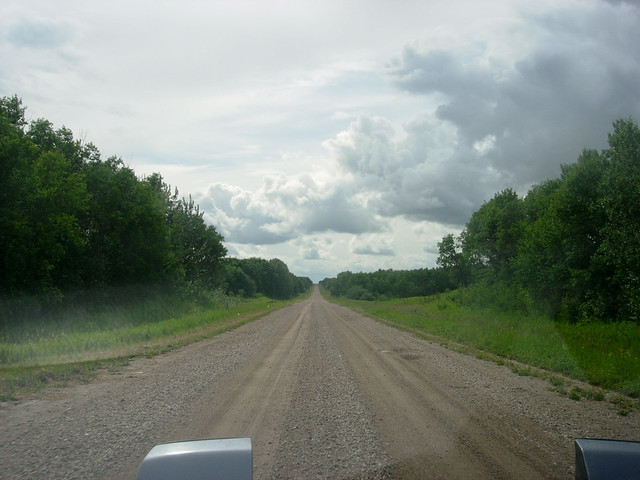
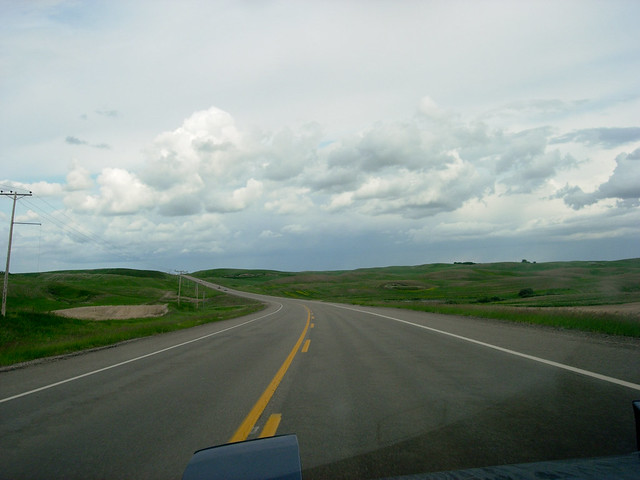
This view of this range road is of a better stretch; during the worse parts I was concentrating on not sliding off the road too much to take any pictures. I got good and slideways on this road, at one point I think my car might have been rotated as much as 30 degrees off of my direction of travel.

SD 063 04 Another Range Road
I tired of the frantic antics of the road I was on, and I found a slightly larger and possibly drier road to take me north towards Highway 784. This one involved fewer fishtails, but the ruts were sufficient many times to render my steering superfluous - I had to stop myself from trying to correct too much my small skids, as I was worried I'd suddenly succeed and send myself straight off the road.

SD 063 05 Highway 784
SD 063 06 Highway 784
SD 063 07 Highway 784
Eventually I reached the comparatively good surface of Highway 784, and turned west. This highway runs from its intersection with the Yellowhead branch of the Trans-Canada Highway (Highway 16) just northwest of Saskatoon to Highway 4, about 30 km north of the town of Biggar. It's almost a straight line, with only two deviations of sufficient size to appear on maps.

SD 063 12 784 Quarry
I stopped for a break on 784 near this... facility which I think is a quarry for sand and/or gravel.

SD 063 15 Blackbirds and Clouds
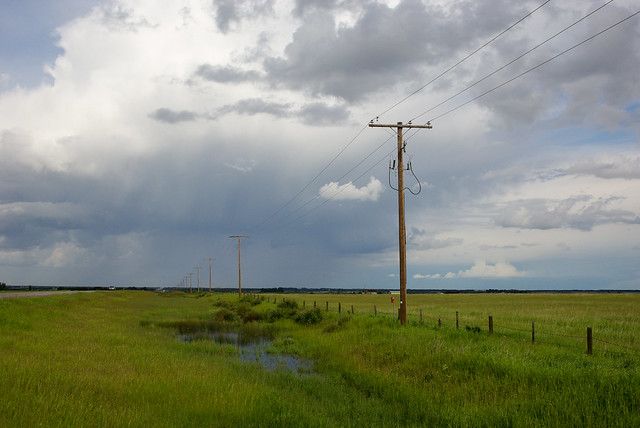
While I was stopped near the quarry, I noticed a large number of red-wing blackbirds (Agelaius phoeniceus) on the fenceposts, and they seemed unable to decide what to do between yell at each other, yell at me, or seek shelter from the approaching storm.

I drove along 784 until I reached the valley where it crosses Eagle Creek, a small waterway that drains into the North Saskatchewan River just north of this crossing. I've stopped at this bridge nearly every time I drive on this highway, I find the small valley and the creek very visually intriguing. A flock of Cliff Swallows (Petrochelidon pyrrhonota) appeared shortly after I stopped, and proceeded to keep the mosquitoes away from me.

SD 063 18 Cliff Swallows flock
I think these swallows may be nesting under the bridge, though there are some fairly steep eroded-soil bluffs not far downstream that they might be using.

Highway 784 climbs a ridgeline into a small patch of forest, then over some open parkland before meeting Highway 4. This bit of elevation (I think there's less than 100m difference between the surface of Eagle Creek and the top of this ridge) is sufficient to prevent too much water building up within the Highway itself, and that part of the drive was over much less rutted and gooey dirt and gravel. My tires are so bad, however, that I still managed to step the back end out a little going around one of the four large, sweeping curves of this highway.

I drove into the town of Biggar, advertised on Highway 4 as having "ALL SERVICES", and filled my gas tank at the Esso station. Even though I have yet to upload the pictures or write up my adventure, in April I ran out of gas in southwest Saskatchewan because the small towns there all contain Co-op gas stations that are closed on Sundays. Esso stations, at least, are open on weekends.

SD 063 10 Highway 14 Curve
Highway 14 also has a few curves, and the pavement means I was in no danger at all of sliding into the ditch...

SD 063 11 Highway 14 Straight
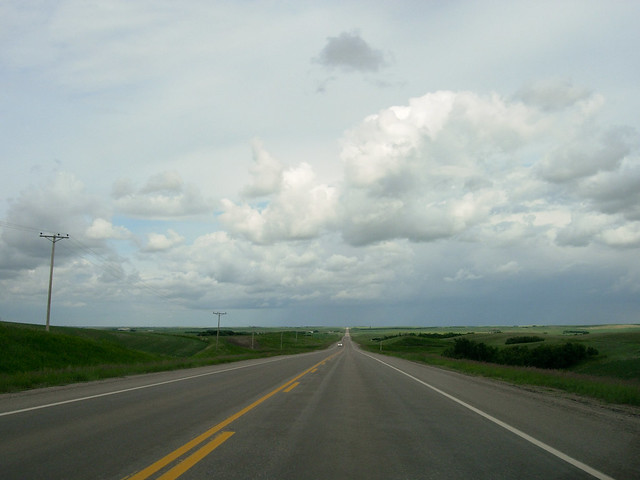
...but most of it is really boring straight road.

Highway 14 took me home, though I did stop two more times, to overcome the boredom of this large highway. Also, pictures, of course.

SD 063 23 Highway 14
Looking east towards Saskatoon, about 35 km from home.

Sunday, May 01, 2011

Sunday Drive 60: Blackstrap Federal Riding

This is a short post, I wanted to get some pictures and content up while it's still almost-topical, before tomorrow's federal election.

Start km: 329392.3
End km: 329953.1
Driven: 560.8 km

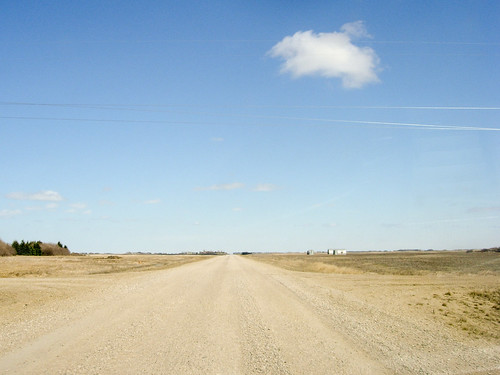
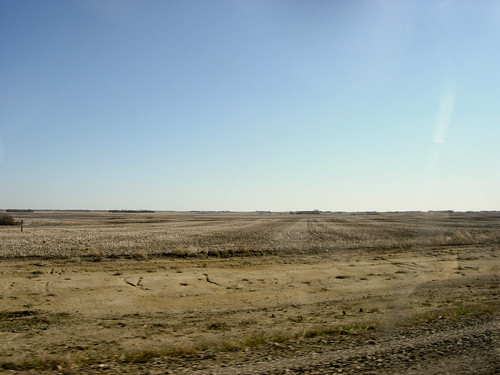
Today I drove most of the perimeter of the Canadian federal electoral riding of Blackstrap, the riding I currently reside in, and the riding in which I will cast a vote tomorrow. I did not set out with any partisan agenda on this drive, I just wanted to see my neighbours, and see the places that will cast votes with me.

Here are a few pictures, I'll put together a more thorough description of today's adventure in a few days, when I'm not so tired.
SD 060 Eastern Suburbs on 8th
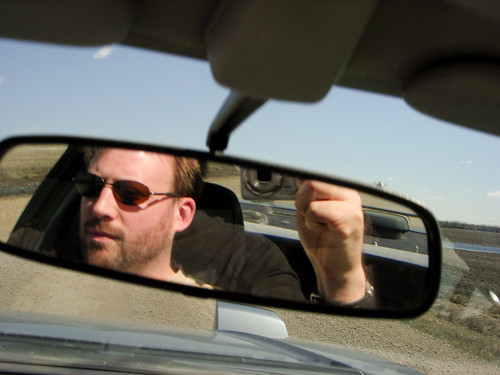
SD 060 Accidental Self-Portrait
SD 060 Near Lanigan
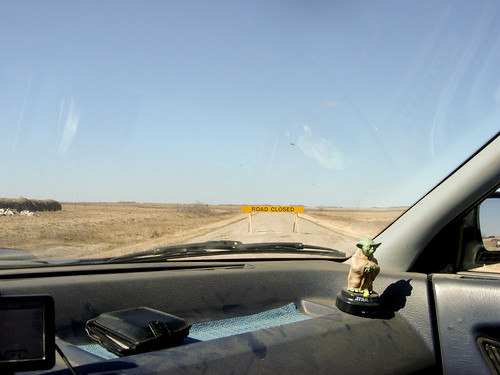
SD 060 Yoda refused to open it
SD 060 Plowed and ready
SD 060 Evening on Highway 11
SD 060 Big Quill NE Border
SD 060 Redneck Pride (my neighbours)